2 Samuel 9: Machir Who Showed Loving-kindness

[Jesus said] “The King will answer and say to them, ‘Truly I say to you, to the extent that you did it to one of these brothers of Mine, even the least of them, you did it to Me.’”

‭‭Matthew‬ ‭25‬:‭40‬

This chapter shows a glimpse of how David ruled his people in Israel – by administering justice and righteousness (2 Samuel 8:15). How a society treats the least and weak is a good reflection of the degree of justice and righteousness of that society. In this chapter, David personally reached out to show kindness to Mephibosheth, a grandson of the fallen previous king, when he did not need to.

At the same time, I would like to highlight Machir, a relatively unknown person in the bible, who showed kindness to Mephibosheth before David searched for him. Let’s not overlook what Machir did.

Chapter Summary

David wanted to show kindness to anyone left of the Saul’s household for the sake of Jonathan. Ziba, a former servant of Saul, was summoned, and David found out that son of Jonathan, who was crippled in both feet, was in the household of Machir in Lo-debar, located in the southeast of the Sea of Galilee. 

Mephibosheth, son of Jonathan, son of Saul, came and prostrated before David. David showed kindness to Mephibosheth and reassured that he would be given back the land that used to belong to Saul and be regularly eating at David’s table. David told Ziba to cultivate the land on behalf of Mephibosheth.

David’s Open Meekness

In the previous chapter, David, being empowered by God the LORD, flexed his muscle to defeat  surrounding nations at all four fronts – south, east, west, and north – to make a name for himself and to receive tributes from them. 

On the other hand, this chapter shows David’s kindness extended to one of the weakest and most vulnerable families and persons: a household of the grandson of a fallen king, who was crippled in both feet. Any descendants or relatives of a fallen king were natural targets for elimination from a new king. Plus, he was handicapped. Therefore, politically and physically, he was one of the most vulnerable person in the entire Israel. It is not strange to see that he lived in the very northern city in Israel, Lo-debar, far away from the land of Judah, where the new king David resided.

That person was Mephibosheth, the grandson of late king Saul. David reached out to Mephibosheth to show kindness to have him dine with David regularly and restore his grandfather’s land when he did not need to. God reached out to us to show grace when He did not need to. David kept his word when he made a covenant with Jonathan to treat his descendants with kindness (1 Samuel 20:14-15). God made a covenant with us unilaterally to demonstrate His grace. Here, we see David showing God’s loving-kindness to the most vulnerable person and family in Israel. 

Jesus told His disciples that whatever they did for the least was equal to what they did to Him (Matthew 25:40). That was what David did. What David did must have been an example of how his governing officials should rule and take care of his people  – by administering justice and righteousness. 

David was not alone. We see another relatively unknown person who showed loving-kindness. 

Machir’s Covert Kindness

Although his name was stated only once in this chapter and not much explanation is given other than he was the son of Ammiel, I want to focus on Machir and his character, especially in contrast to that of Ziba. 

Although Ziba was the official servant of Saul, it was Machir who gave practical help to Mephibosheth by showing hospitality and providing shelter for him for many years. Was there a real need or obligation or any benefit associated with taking care of Mephibosheth for Machir’s perspective? Not much. Mephibosheth was a grandson of Saul, a fallen king, who could pose much more liability than benefit for Machir. 

Taking care of Mephibosheth, a grandson of a fallen king, must have posed a great liability with little benefit for Machir, especially in the era of the new king. It was possible that Machir simply regarded Mephibosheth as a broken person in need. Mephibosheth lost both his father and grandfather at the battle of Gilboa (1 Samuel 31). With both of them dead, his royal status plummeted to the level lower than that of an ordinary citizen. Besides, he was crippled. Despite all these factors, Machir undertook a great risk to take Mephibosheth under his protection. Machir had nothing to gain from taking care of Mephibosheth, but he did it in accordance with God’s loving-kindness. In addition, when David and his men were feeling from Absalom with a weary state, Machir was also one of the people who brought food to them in Mahanaim (2 Samuel 17:27-29).

Ziba the Shrewd Wealth Builder

On the other hand, Ziba as a servant of Saul was supposed to be the official caregiver of Mephibosheth. Ziba was “helpful” by informing the location of Mephibosheth to David. However, instead of taking care of Mephibosheth, he seemed to have found a way to enrich himself by having multiple wives, along with many sons and servants (2 Samuel 9:10). It is not exactly possible to know how he enriched himself when the Saul kingdom fell, but we can make an educated guess that he was a shrewd man, who knew how to take advantage of changing political landscape to obtain additional wealth. 

We see more evidence later of his shrewd nature in building his wealth. In 2 Samuel 16, when David was fleeing from his son Absalom, Ziba acted swiftly before Machir and others to aid David with food, but lied to David that Mephibosheth was delighted when David was running away from Absalom. When David heard this, he gave everything that belonged to Mephibosheth to Ziba. Then, Zina prostrated himself before David (2 Samuel 16:1-4) – note that Ziba did not prostrate before David in the first encounter, but only when he was promised for additional wealth. This episode showed that Ziba was a shrewd man, who knew how to grow his wealth by trickery in a turbulent political situation.  It was possible that Ziba could have accumulated his wealth in a similar manner after the fall of King Saul. 

Conclusion

David showed loving-kindness to one of the most vulnerable households in Israel openly: the grandson of Saul. By treating the weak with dignity, he showed a glimpse of what it meant by administering justice and righteousness to the people of Israel. Machir was a hidden hero – who showed compassion to take care of Mephibosheth, which carried a great risk. However, we have people like Ziba, who was a shrewd person in building his wealth by taking advantage of political turmoils. The chapter shows a microcosm of this world – we may have people with genuine hearts to help the weak, but people who are very shrewd in building their wealth. 

Which one would you be?
2 Samuel 8: Overcoming Four-front War and Conquering Kingdoms by Faith

David overcame a four-front war by defeating the Philistines, the Moabites, Hadadezer king of Zoba, Arameans, and the Edomites. The author of Hebrews describes his conquest of these kingdoms as an act of faith.

Summary: 

After God’s promise to build a house for David, David defeated and subdued many surrounding nations, including the Philistines, the Moabites, Hadadezer king of Zoba, Arameans, and the Edomites. Internationally, David defeated the nations on the west, east, north, and south because the Lord helped him to achieve victories wherever he went (2 Sam 8:6 and 14). Domestically, David reigned over all Israel by administering justice and righteousness. 

Non-discriminatorily Defeating Enemies around the Border by Faith 

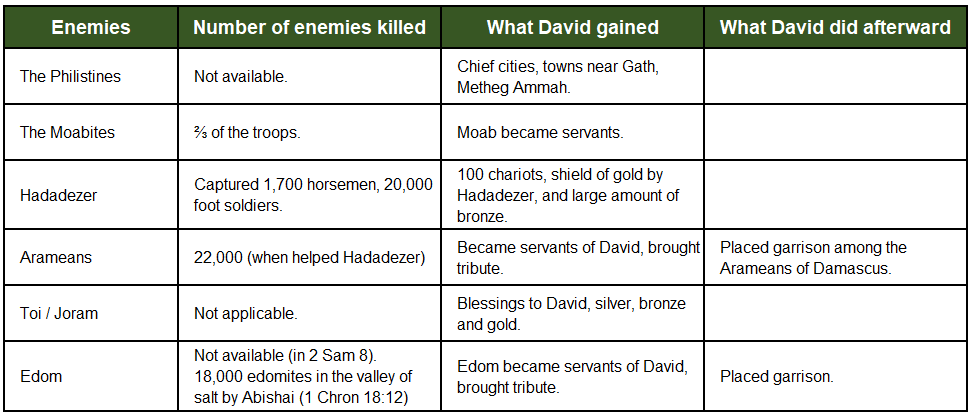
The table below summarizes David’s exploits against his surrounding nations. To the west, he subdued the Philistines and took their major cities. To the east, David defeated the Moabites and they became David’s servant, bringing tributes. To the north, David attacked Hadadezer as well as Arameans, who came to help Hadadezer. David installed a military presence around Damascus. To the south, he defeated the Edomites and they brought tributes to David. 

Table 1: Summary of David’s Exploits against Surrounding Nations

Defeating Enemies by Faith: Fulfilling Promise of 400 year-old

… David  and Samuel and the prophets, who by faith conquered kingdoms, performed acts of righteousness, obtained promises…put foreign armies to flight.

Hebrews 11:32-34

The author of Hebrew makes a statement that it was by faith that David “conquered kingdoms, performed acts of righteousness,” and “put foreign armies to flight.” The statement by the author of Hebrew matches the details of 2 Samuel 8 very well. Then, what does it mean that David conquered kingdoms by faith? I believe David’s actions were considered faith because they were aligned with God’s promises, and David acted in full dependence and partnership with God. 

More specifically, David’s conquest and subjugation of His enemies was in some way an extension of God’s promise and command that would go all the way back to Joshua. God said to Joshua that “Your territory will extend from the desert to Lebanon, and from the great river, the Euphrates — all the Hittite country — to the Mediterranean Sea in the west (Joshua 1:4),” which was much more than the Isrealite territory and includes all the land that belonged to David’s enemies in 2 Samuel 8: Philistines, Moab, Edom, Hadadezer, Arameans, and Hammath. As David ousted the Jebusites to fully conquer Jerusalem to fully claim God’s inheritance, so did David defeated the external enemies around Israel. 

Defeating Enemies by Faith: Overcoming Four-front war

Although we do not know the exact details and timing of these wars (against Philistine, Moab, Aram, Edom), that David was able to defeat his enemies in all four-fronts is noteworthy.

Let’s compare David’s exploits with what Germany tried to do during the first and second world wars. In the first world war, Germany developed a plan to overcome a two-front war risk posed by France to the west and Russia to the east. The Schlieffen plan was to make a swift campaign on the western front to defeat France, then to redirect the troops to the Eastern front to subsequently defeat Russia. The plan failed as the German offensive came to a standstill at the Marne (a river in France) and the Russians mobilized quicker than the Germans envisioned. At the start of the second world war, Germany used blitzkrieg (a term used to describe a method of offensive warfare designed to strike a swift, focused blow at an enemy using mobile, maneuverable forces, including armored tanks and air support) to swept through France, Poland, Norway, Belgium, and Holland and France with astonishing speed and force. However, German forces’ blitzkrieg proved less successful against Soviet defenses, and Germany eventually re-postured itself into a defense war. 

Even formidable German forces  in two world wars were not able to overcome the two-front war. However, David was able to do it – by the power of the LORD his God. Something for us to note in our mind. 

God’s Faith in David: David’s Name to be Great 

It is said David made a name for himself. Was this a statement that David was elevating himself? 

No. Back in 2 Samuel 7, God promised that he would make David’s name great like a great man on the earth. This statement does not indicate that somehow David fell into arrogance, but instead shows a fulfillment of God’s promise to lift up the name of David. 

Defeating Enemies by Faith: Following the LORD’s command wholeheartedly

Another sign of David’s faith in God was how he treated the horses when he captured 1,700 of them. A rational way is to have these stolen horses to be spared and used for future war against adversaries. However, David hamstrung most of the horses (1600 out of 1700) and left only 100 for chariots. When Joshua defeated the Northern coalition forces in Canaan, he also hamstrung their horses and burned their chariots with fire (Joshua 11:9). Likewise, David followed the command of the LORD in Deuteronomy to not rely on chariots or horses (Deuteronomy 17:16), but only on the LORD God for the battle against adversaries. 

Defeating Enemies by Faith: Through Mighty Warriors 

The LORD helped David achieve great victories wherever he went (2 Samuel 8:14). This statement does not necessarily mean that the LORD God gave victories to David in a supernatural way all the time. God often works through people – this time, God provided David through many competent, loyal warriors. 

One of the key reasons for David’s victory was his mighty, loyal warriors. Although 2 Samuel 8 does not describe David’s warriors in detail, 2 Samuel 23:8-36 lists and highlights all the mighty warriors, 37 in total and their exploits. We need to notice that it was not David alone who made these great exploits. These exploits were accomplished with his competent, mighty warriors who were loyal to David. The meaning of the LORD helping David includes the LORD’s empowerment of David through his mighty warriors. God often manifests His power via His people. 

Nation that Administers Justice and Righteousness

While defeating external nations around Israel, David ruled Israel internally by administering justice and righteousness. What does it mean by ruling by administering justice and righteousness? It probably means that David governed the nation by the two major commandments stated in the Law of Moses: 1) loving God; and 2) loving neighbor as yourself. Loving God was reflected in the worship system that David established by organizing the Levites (2 Samuel 6 and 1 Chronicles 15-16). Loving neighbors can be practiced by implementing detailed rules and regulations laid out in the book of Moses (from Exodus to Deuteronomy), which comprises moral, social, and business ethics. One of the concrete commands that practice caring for neighbors is in Leviticus 19:9-10, which states not to gather all the gleaning and not to go over the vineyard a second time to pick up graves. These commands were given to share the wealth that God promises to bless the Israelites in a way to protect the dignity of the poor, widows and orphans. A nation that administers justice and righteousness provides a way for the poor to live while protecting their dignity. 

Be Victorious Christian!

Externally, David defeated the enemies by conquering them. Internally, David administered justice and righteousness to his people. David used the power that the LORD God gave him appropriately. He used power to defeat the external threats and to defend his people. This kind of appropriate use of power is called “meekness.” 

Jesus demonstrated the pinnacle of meekness. For us, He died on the cross to save us. To His enemy, Satan, He crushed its head. Likewise, for those of us, who have power, intellect, wealth, let us use them meekly, in the way in which Jesus and David used.