Second Thessalonians: Be Prepared to Stand Firm

Before His crucifixion, Jesus told His disciples, “If the world hates you, you know that it has hated Me before it hated you (John 15:18).” In other words, do not be surprised if the world hates you, followers of Christ.

Faith is an intimate relation between Christ and His followers. Growing faith is an action. Growing faith will be hated by the enemies of God, and associated battles will be inevitable. Therefore, faith must be practiced, trained, and disciplined to stand firm until the end. 

The second letter to the Thessalonians directly and indirectly describes the kinds of battles that the followers of Christ faced, are facing, and will be facing. More importantly, however, the letter highlights the fundamental principles of God that would empower the Thessalonians to withstand those battles. 

Chapter Summary

What kind of attacks do the followers of Christ face? Enemies of God launch multi-pronged attacks on the followers of Christ, especially those who are growing in faith. Apostle Paul’s second letter to the Thessalonians provides a great, vivid example of three kinds of attacks: 1) brute persecutions from the Jews; 2) confusing, disturbing false message of the coming of the Christ; and 3) disorderly lives of some Thessalonians who belong to the church. 

The letter not only describes the attacks, but apostle Paul implicitly counters them by highlighting the principles of God, providing specific commands to the Thessalonian church, and praying for them. 

Each chapter corresponds to different kinds of battle that the Thessalonian church was undergoing. Chapter 1 addresses a situation that pertains to the direct, physical persecution of the Jews in Thessalonica. Chapter 2 depicts a situation where people were confused with false messages. In Chapter 3, Paul urges people to work and concludes with his prayer for the Thessalonian church. 

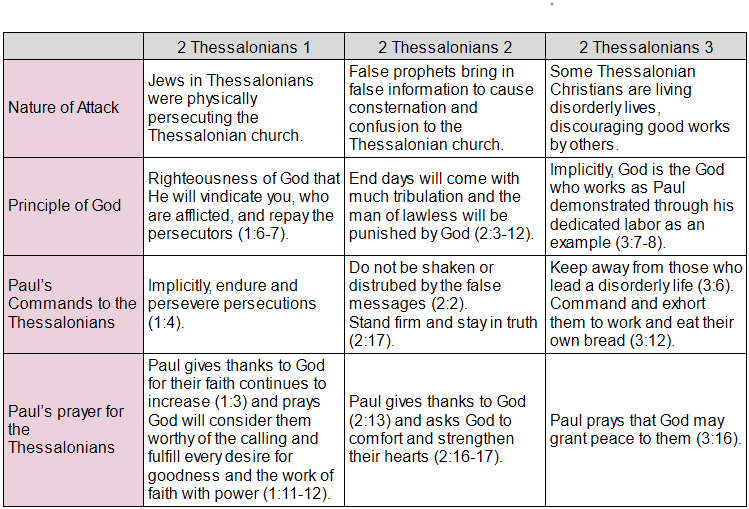
The table below provides a snapshot summary of the entire Second Thessalonians by chapter and criteria. 

In each chapter, the nature of attack on Christians is either explicitly or implicitly stated. In each chapter, Paul encourages the Thessalonians by reminding them of the relevant principle of God and in addition, gives customized commands to withstand the attacks. In each chapter, Paul includes prayers to strengthen them. the main takeaway applicable message is that we fill face attacks, but we have God and prayer to counter them. 

Conclusion

Last Sunday was Easter when we celebrated the victory of Christ. Some of us may be undergoing severe battles as the Thessalonian church did about 2000 years ago. I pray that you will be victorious by reminding yourself of God’s principles and being empowered by prayers of other fellow followers.

1 Thessalonians 2: Agape in the Midst of Fierce Battle

Some of the key repeated concepts in the entire letter of Thessalonians are as follows: hardship, suffering, and trials. None of these terms are popular. However, these were very frequently associated with the advancement of the Gospel and the church. The entire letter of Paul to the Thessalonians revolve around them. Paul, his companions, and the Thessalonian church were in the midst of fierce external and internal battles.

Summary

Apostle Paul states that he came with boldness in God to speak to the Thessalonians about the gospel of God despite a strong opposition from the local Jews. At the same time, Paul and his companions were gentle to the Thessalonians as a nursing mother nurtures her tender child. 

Paul further reminded them that he and his companions labored hard to serve the Thessalonians. Furthermore, Paul also constantly thanked and prayed for them because they received the word of God. Paul complimented them that they became the imitators of the churches of God in Christ despite severe persecution from the Jews. 

For that reason, Paul expressed his strong desire to come and see them because they were Paul’s glory and joy.

Paul’s Boldness in Truth

In all of Paul’s epistles, he showed confidence – confidence in God rooted in the truth of Gospel. He knew that in all his soul and body that he was the messenger with the authority approved by God (1 Thess 2:4 and 2:6). For that reason, he was able to come to the Thessalonians with boldness (1 Thess 2:2), not with flattering speech or a pretext for greed (1 Thess 2:4). 

Jew’s Boldness in Brute Force

On the other hand, let’s contrast the violent behaviors by the Thessalonian Jews with the boldness in truth displayed by Paul. The Jews were bold on the outside, wildly swinging their brute force. They had the power to severely persecute Paul, his companions, and Thessalonians (Acts 16:5, 16:13). However, this persecution by violence was merely an expression of their insecurities.

What were they afraid of? The Jews were afraid of losing their political privilege with a potentially diminished number of followers of the Jewish tradition if they started to follow Christ. The Jews were filled with jealousy because they posited that their exclusivity as the people of God would be tainted by the influx of the Gentiles. To them, protecting their privileges was of utmost importance. Therefore, when the Gospel threatened their prime interests, they became fearful and started to express violence to suppress the truth that Paul and his companions were preaching.

Invoking God’s Wrath

In response to the Jews, Paul had never taken personal vengeance on them. Instead, notice how Paul took this issue to God by invoking His wrath. Paul stated that not only did they fail to please God, but also were working against all humanity (1 Thess 2:15). The accusation that Paul invoked was extremely strong – the Jews were working against all humanity! Why did Paul decide to go this far?

The sin that the Jews were committing was similar to what the serpent did in Genesis 3 by driving a wedge between man and God. The serpent separated man from God by introducing sin to the world. The serpent was “hostile to all people (1 Thess 2:15).” That was what the Thessalonian Jews were doing. Therefore, Paul was making a very strong statement by invoking the wrath of God (1 Thess 2:16). 

Agape >> Fierce External Threats

Despite the persecution by the Thessalonian Jews, the love and longing between Paul and the Thessalonian church continued to grow. Even in the midst of severe persecution, Paul and the Thessalonians started to anchor greater hope in each other in the presence of Lord Jesus.

This is the biblical love. Love that transcends persecution, difficulties, and trials – active love.

1 Thessalonians 1: Receive, Reorient, and Resonate

Receive. Reorient. Resonate. These three terms came to my mind when I read the first chapter of 1 Thessalonians. They received the power. They reoriented their hearts to serve the true and living God. Their influence resonated through the entire region. Paul, Timothy, and Silvanus were extremely thankful and joyful to hear this great message.

Background

Thessalonica was one of the cities that Paul visited during his first missionary trip (Acts 17:1-9). He stayed in the city for three Sabbaths only, after which he had to flee southward due to a severe, violent persecution by the jealous Jews. 

However, the church of the Thessalonians must have been very dear to the heat of Paul, Timothy, and Silvanus. Although the total stay in the city was short, this first letter to Thessalonians showed no shortage of expressed yearning and brotherly love from Paul. What enabled Paul, Timothy, and Silvanus to develop such a strong bond with the Thessalonian church and its saints? Let’s explore this in the five chapters of 1 Thessalonians.

Summary

Paul is giving thanks to the Thessalonians for their work of faith, labor of love, and perseverance of hope. He states that the Gospel came to them in power with full conviction. As a result, the Thesslanians became the imitators of Paul and of the Lord, receiving the word with joy despite ongoing great trials and afflictions. Because of the joy with which they received the word, they became a great example of Christians to all the believers in Macedonia. They also turned to God from idols, served God, and waited for the coming of His Son from heaven. 

Recipient: Church

Very clear and important was the recipient of Paul’s letter: the church of the Thessalonians. Although Paul visited the synagogue of the Jews for three Sabbaths in Thessalonica (Acts 17:1-3), the primary recipient of the letter was the church. 

Then, what is church? As Paul’s main message indicated during the three Sabbaths in the synagogue, church is the assembly of people who profess Jesus as the Christ (Acts 17:2). Although he preached the message to the people at the synagogue at that time, his letter was addressed to the people of Christ, not the people at the synagogue. Again, church is the assembly of people who profess Jesus is the Christ – in other words, Jesus as their master and Lord. 

First Step: Received the Gospel in Word and Power

Paul states that “our gospel did not come to you in word only but also in power and in the Holy Spirit and with full conviction (1 Thess 1:4).” What a statement. Let’s unpack this profound statement by focusing on the two terms, “word,” and “power.” 

The Gospel came in word. Let’s not take this for granted. Why is this important? It is important because words can be understood by finite people like us. It came in words so that the Thessalonians can grasp the love languages of God. In addition, it came with power. The absolute power resides in the Gospel because it unshackles us from the grip of the power of death to eternal life with God. 

The opportunity to receive the Gospel is utterly by the sole grace of God. The Gospel is the most precious gift to mankind. Paul was the messenger to the Thessalonians. That Thessalonians received the Gospel through Paul was by grace. 

Second Step: Reorient and Grow

The Thessalonians received the Gospel in word and power. By seeing Paul’s prayer for them, we can tell three important elements that pertain to the reorientation and growth in Christ (1 Thessalonians 1:2-3). 

  • Work of faith: Faith is a relation with and an utter trust in Christ. Any relation requires sincere work. Paul wanted to include this in prayer so that the church of the Thessalonians continue to work on deepening their relation with Christ. This is not saying that work is required to be saved – this is solely based on the grace of Jesus Christ. However, as faith is an active relation between two entities, it makes sense to use a phrase, “work of faith.”
  • Labor of love: Loving your God and neighbor is not a natural extension of man’s heart and behavior. The world often uses a phrase like “falling in love” as if love is a passive and emotion-driven element. However, biblical love is agape. Love requires labor. It needs to be deliberate and action-oriented. God demonstrated this by persistently chasing the Israelites, His people, by eventually sending Jesus to forgive and save them. Paul wanted the Thessalonians to labor to show love.
  • Perseverance of hope: Reorient your perspective to behold the great glory with Christ in the near future. The church of the Thessalonians was under severe afflictions from the Jews. Therefore, Paul was encouraging them to persevere and look for the future of Christ and His glory.

The Thessalonians seem to be already demonstrating the results of these. As they “turned to God from idols to serve a living and true God, and to wait for His Son from heaven (1 Thess 1:9-10).”

Third Step: Resonation

The Thessalonians had already become influential as they became imitators of Christ and Paul demonstrated joy despite ongoing great trials and afflictions (1 Thessalonians 1:6). This was one of the key attributes that distinguished the genuine followers of Christ from others. Because of the expressed joy, they became a great example of Christians to all the believers in Macedonia. 

So let us pray that we will receive the word of God, let the Holy Spirit reorient our hearts, and let the work of God resonate from us.

Book Reviews 2020

Year 2020 went by so quickly and so slowly at the same time. As usual, I spent a good portion of my time reading books. Although I am not a fast reader, I like to read books consistently. In 2020, I finished 19 books total, not too few and not too many, and am still currently reading a few more books.

Although most of my blog comprises postings from a weekly bible study, many books that I read are not exclusively related to Christianity. As an energy economist, I tend to read books related to economics and energy. Reading books across a wide variety of topics helps me to gain a new perspective on the Word of God as well. 

Here’s a list and succinct summary of the books that I read in 2020, starting with four books on economics history. 

  • The Commanding Heights: The Battle for the World Economy. By Daniel Yergin, ‎Joseph Stanislaw. 1998
  • Capitalism Alone: The Future of the System that Rules the World. By Branko Milanovic. 2019
  • The Meritocracy Trap: How America’s Foundational Myth Feed Inequality, Dismantles the Middle Class, and Devours the Elite. By Daniel Markovits. 2019
  • The Zero Marginal Cost Society: The Internet of Things, the Collaborative Commons, and the Eclipse of Capitalism. 2014

Only in hindsight, I realized that these four books are very intertwined with each other. The Commanding Heights depicts the major idea battle in the 20th century between the state-led and market-led commanding heights, the term first used by Lenin that indicate key industries of the nation, including utilities, natural resources, and other sectors in foreign and domestic trades. Capitalism Alone provides descriptions of two representative forms of capitalism – liberal meritocratic capitalism and political capitalism – led by the United States and China – and makes a general outlook for these two from now in 2020. The Meritocracy Trap is a thought-provoking book that shows serious side effects of the promotion of meritocracy in the developed world, especially the United States. The Zero Marginal Cost Society depicts a current trend in many sectors where cost of production is falling to zero, which may dismantle the current capitalism system into a system of collaborative commons. 

Comparing and contrasting views on capitalism by Capitalism Alone with the Zero Marginal Cost Society would be an enriching thought exercise to assess how the world’s commanding heights will evolve in the near- to mid-term future. 

  • The New Jim Crow: Mass Incarceration in the Age of Colorblindness. By Michelle Alexander. Originally published in 2010. New edition in 2020. 

This book revealed so many unjust elements in this society that I was completely oblivious of. Don’t be fooled by the successes of the likes of Barack Obama, Oprah Winfrey, or LeBron James. The system of slavery is gone. Jim Crow laws are gone. Yet, the New Jim Crow is a systematically-discriminating legal prison system, especially against the colored, in the United States, which started with the War on Drugs in the 1980s. Read the book. We need to know the hidden injustice. 

  • The Art of Loving. By Eric Fromme. 1956
  • Encounters with Jesus: Unexpected Answers to Life’s Biggest Questions. By Tim Keller
  • Knowing God. By J.I. Packer

Although I am not sure whether Eric, the author of The Art of Loving, is a follower of Christ or not, I think this book should be highly recommended within Church communities. It will challenge us to rethink the concept of love, which requires discipline, concentration, and practice. The world teaches that we fall in love (based on emotion), but God’s love is an action that emanates from one’s totality. Love is a complete interpersonal union. Not an easy read, but a short, compact book of 117 pages. 

Encounters with Jesus by Tim Keller provides numerous examples of people meeting with Jesus in the Bible. Knowing God by J.I. Packer will enlarge your knowledge of God in many perspectives. Go ahead and read them. 

  • AI Superpowers: China, Silicon Valley and the New World Order. By Kai-Fu Lee. 2018 

Artificial intelligence (AI) is a buzz-word these days. Kai-Fu Lee had ample experiences in leading tech companies in both the United States and China and laid out their comparable positions in four areas of AI: internet, perception, business, and autonomous. He states that the competition and dynamism in the China tech ecosystem far exceeds that in the Silicon Valley. A surprising element in the book is the author’s personal story. After he suffered from an outbreak of cancer, he realized the very importance of family and love. Since then he has been focusing on developing AI technologies to serve people, not the other way around, with a focus on family love.  

  • Economics of Electricity: Markets, Competition and Rules. By Anna Cretì and Fulvio Fontini. 2019
  • Solar Power Finance Without The Jargon. By Jenny Chase. 2019

These two books relate to my profession, economics of electricity markets. 

The first one Economics of Electricity speaks to the “soul” of the electric industry, which comprises regulations and market rules to facilitate healthy market operation and competition to benefit consumers. The book uses some graduate-level mathematics to explain important concepts, but not too difficult.  

The second book on Solar Power Finance provides a story of the author’s joining start-up called New Energy Finance, which was eventually acquired by Bloomberg. 

  • Leadership: In Turbulent Times. By Doris Kearns Goodwin. 2018

The book portrays four past presidents in the United States: Abraham Lincoln, Theodore Roosevelt, Franklin Roosevelt, and Lyndon Johnson. All four of them had a few monumental achievements whose effects still resonate large today. However, these achievements did not come easy. All four of them underwent excruciatingly difficult personal trials, which could have broken them completely. Yet, they emerged more mature and strong. Highly recommended. 

As Christians, what I learned from this book, among many things, is the posture that we can take in times of fierce trials. 

  • The Intelligent Investor. By Benjamin Graham. 1949
  • The Essays of Warren Buffett: Lessons for Corporate America
  • Rich Dad Poor Dad: What the Rich Teach Their Kids About Money that the Poor and Middle Class Do Not! By Robert Kiyosaki. 1997

Because the year 2020 had such a tumultuous stock market, I picked up a few books on the core principle of investment. Graham and Buffet (who is considered a protege of Graham) continued to emphasize the importance of value investing, not speculation. Put some analytical mind to uncover solid companies and be a partner with them for a long-term (at least 10 years). These books do not teach how to trade, or how to time market, which is impossible to do.  

Rich Dad and Poor Dad provides a valuable insight on differentiating assets from liabilities. This differentiating will give you the financial freedom that you desire. 

  • Being Mortal: Medicine and What Matters in the End. By Atul Gawande. 2014

If you have any loving people becoming old and fragile, and even if you don’t, this book is a great read. This is Atul’s personal reflection from many interactions with aging patients, including his own father. The book emphasizes nurturing the well-being of these aging people, respecing their freedom, not just their fancy high-tech treatment or safety. 

  • Thinking Slow and Fast. Daniel Kahneman. 2011

An insightful book on a dichotomy between two modes of thought:  “System 1” is fast, instinctive and emotional; “System 2” is slower, more deliberative, and more logical. The book contains many examples of how these two compete, interact, and compliment each other. Many instruction examples will entertain you. 

  • The Polymath: Unlocking the Power of Human Versatility. By Waqas Ahmed. 2019
  • Polymath: Master Multiple Disciplines, Learn New Skills, Think Flexibly, and Become an Extraordinary Autodidact. By Peter Hollins. 2020

Have you heard the term polymath before? The 21st century belongs to polymaths. A polymath is “an individual whose knowledge spans a substantial number of subjects, known to draw on complex bodies of knowledge to solve specific problems.” This synthesizing ability across different disciplines will become more and more important in the 21st century. Be aware of narrow specialization, the book argues. 

The first book provides a deeper explanation and the encyclopedia-like list of polymaths across different time periods, nations, and culture. The second book is a shorter version that focuses on the application on how to become a polymath.

Ruth 4: Celebration

The story ended in chapter 3 in suspense. Ruth and Naomi were waiting in a mixture of great expectation and anxiety because their status would be changed in the next 24 hours. They would be redeemed by either the closest redeemer, whose name was never revealed, or Boaz. Ruth and Naomi would prefer Boaz. However, nothing was certain at that time.

Summary of Ruth 4

Boaz acted immediately. While he was near the city gate, he happened to see the closest relative. Then, he quickly summoned the ten elders of the city and explained to them that Naomi came back from Moab to Bethlehem and she needed to be redeemed. At first, the closest relative said that he would redeem. Then, Boaz explained further that redemption would include not only Naomi’s land, but also Ruth the Moabite, the widow of Mahlon, in order to raise up the name of the deceased. Then, the closest relative told Boaz that he could not redeem it. Boaz, who was next in line for redemption, officially proclaimed that he had bought the land that belonged to Naomi and acquired Ruth to be his wife.

Boaz married Ruth and they had a son named Obed. The whole village celebrated and blessed Naomi as well. This Obed came to be the grandfather of king David.

Repeated Keywords

In an Inductive study, we examine the text closely to make a few simple, fundamental observations on the frequently repeated phrases and words. Here are a few repeated keywords: redeemer, redeem, Boaz, deceased, fathered, and witnesses,

Boaz was repeated eight times. The chapter clearly showed that the main character in chapter 4 was Boaz. The main repeated verb was redeem. Therefore, the main continent of this chapter was that Boaz redeemed Ruth and Naomi. However, this event did not just take place at the individual or the family level. Plenty of witnesses partook and confirmed this redemption event, and this signified that the redemption was for the whole community to celebrate. Then, there was a dramatic change in status from the deceased to “life” for Naomi, Ruth, and even Elimelech. As a result of this event, they became the ancestor of King David, who was the representative physical ancestor of LORD Jesus.

Boaz: A Man of Action

As Naomi predicted, he immediately launched into action to settle the matter related to redemption. He happened to meet the redeemer in the city gate and quickly summoned ten elders of the city. We briefly see how the LORD guided Boaz to meet the redeemer near the city gate on that very morning. Also, we can see the extent of Boaz’s (positive) influence in the city by the quickness with which he was able to summon all the elders in a very short time.

Swift, Decisive Proclamation

Although the closest redeemer was willing to redeem Naomi’s land initially, after being informed about his additional duty to acquire Ruth the Moabite, he stated he could not redeem (Ruth 4:9). With his refusal, Boaz made a swift, decisive proclamation. Boaz proclaimed to all the witnesses that he redeemed the land of Naomi and acquired Ruth to be his wife in order to raise up the name of the deceased. It was a firm statement that no one could object.

Let’s notice a few things. Boaz followed the principle thoroughly. Based on the law of Moses laid out by God, he followed it step-by-step, ensuring that every important person, the closest redeemer and the ten elders, were summoned and consulted. Boaz, although being wealthy and very influential, did not circumvent the law and procedure laid out by God.

When God was to redeem us from sin, the all mighty God could have used His power to unilaterally forgive. However, even God, He subjected Himself under a “proper process.” In order to save us from sin, a sinless person had to shed his blood to free us from sin. He allowed Jesus to undergo death on the cross to free us from the dominance of sin. God followed the process. So did Boaz in a miniature manner.

Side Note: Nameless Redeemer

On a side note, the name of the closest redeemer was never revealed in this chapter. There are potentially two reasons for this – one for negative, and the other for positive.

The first reason for his anonymity was that his name was irrelevant overall. Because he refused to redeem, the author of this book saw no need to reveal his name.  

On the other hand, the second reason was to protect his descendants from humiliation. The author could have deliberately shielded his name. If his name was revealed, the descendants of his family may have felt shamed because the closest in line refused to redeem.

Boaz and Ruth’s City-wide Celebration

This event was not to be an isolated event. Marriage and celebration permeated to the whole community. The word witnesses was repeated three times (Ruth 4:8, 9, and 10). Although the redemption took place at a private and family level, this became a public event in the presence of many witnesses. The ceremony of redemption was to be witnessed by the people. Because of what Boaz did to redeem Naomi and Ruth, the whole village indirectly experienced a key aspect of the character and the law of God, which gives life and hope to those who had fallen and been subjected to captivity of poverty and no inheritance.

Besides, we see that the LORD God is the one who literally gives life. The LORD allowed Ruth to conceive – in contrast, Ruth was childless when she was married to Mahlon.  It is only the LORD who determines life and death. The gift of life is common around us. Yet, everyone is precious because without God’s permission a new life would not be realized.

Coming Home

This whole book of Ruth reminded us of the parable of the lost son given by Jesus (Luke 15:11-32). The second son ran away from the presence of the father and eventually came back to be embraced and redeemed by the father. In a similar manner, Naomi stepped away from her hometown to spend 10 years in the land of Moab before coming back to her home, where God was waiting with a hidden treasure. In her hometown, Naomi and Ruth were redeemed.

Jesus Christ: The Ultimate Redeemer

Borrowing the definitions provided by Merriam Webster dictionary, redeem means: 1) to free from captivity by payment of ransom, and 2) to free from the consequences of sin.

With his wealth and willingness to marry Ruth, Boaz freed Naomi and Ruth from the captivity of poverty and the risk of losing their name forever without inheritance. On a far greater level, Jesus was the ultimate redeemer who freed us from the consequence of sin with the payment of His life.

Let us remember Jesus Christ the Redeemer in this season of the year.

Ruth 3: Risk and Suspense

Although two main characters of the book of Ruth are Ruth and Boaz, in this chapter, I gave a little bit more focus on Naomi and the important role that she played as a connector in this chapter. 

Summary of Ruth 3

At the end of the barley harvest period, wanting to provide a safe family for Ruth, Naomi gave a specific instruction for Ruth to go see Boaz at the threshing floor. Ruth obeyed and went down. 

At the threshing floor, Ruth waited until Boaz had finished eating and drinking and let his heart merry. After he went to lie down, Ruth approached him quietly and uncovered his feet and lay down. In the middle of the night, Boaz was startled by the unexpected presence of Ruth. Ruth asked Boaz to redeem her and Naomi. Boaz praised Ruth for showing kindness and informed her that there was a closer relative, who was first in line to redeem. Boaz told Ruth that he would redeem Ruth and Naomi if the closer relative refused to do so.

Ruth went back to Noami and told everything that had happened. Namoi was certain that Boaz wouldn’t rest until the matter had settled. 

Naomi the Connector

Naomi played a crucial role in connecting Ruth with Boaz in this chapter. The time gap between chapter 2, the beginning of the harvest period, and chapter 3, the end of the harvest period, was two to three months. During this time, Ruth did what she did the best by diligently gleaning. Boaz did what he did best by providing a generous opportunity for people like Ruth to glean. This day-to-day happenings lasted for two to three months. 

Then came Naomi, who was instrumental in connecting Ruth with Boaz. Naomi must have seen and heard the character of Boaz. Naomi also must have sensed how Ruth thought of Boaz. Perhaps, noticing the opportunity and the hesitancy from both Ruth and Boaz, Naomi took the initiative to build the first step for them to be connected as a potentially redeemer-redeemed pair. Naomi gave an instruction to Ruth to anoint herself and change to her best clothes (to signify that she was no longer a grieving widow) and go down to the threshing floor where Boaz would be threshing harvested grains (Ruth 3:3-4). In fact, Naomi was instructing Ruth to propose to Boaz as a redeemer-redeemed pair. Without Naomi’s intervention and active role as a connector, a private meeting between Ruth and Boaz might not have happened.  

Ruth the Risk Taker 

Ruth obeyed Naomi by following her instruction (Ruth 3:5). She took a great risk by going to the threshing floor, which was typically located outside the village. Walking to the threshing floor alone and staying there until late night as a woman can be a risky venture. Plus, this was during the times of Judges, when the level of the fear of God was low society-wide. Regardless, Ruth obeyed and took this risk to have a private encounter with Boaz. 

Boaz’s Reaction: Second Kindness > First Kindness

After drinking and eating, Boaz was merry and lay down. In the middle of the night, he was startled to find out that a woman was at his feet. It was Ruth. Ruth asked Boaz to spread his garment over her as he was a close relative, a redeemer (Ruth 3:9). Notice the word, “garment”, is the same word that denotes the wing of the God of Israel (Ruth 2:12 May the Lord reward your work, and may your wages be full from the Lord, the God of Israel, under whose wings you have come to take refuge). This request to redeem her and Naomi’s family was practically a marriage proposal. This can be a risky situation because Ruth can be rejected and spurned by Boaz. .  

In response, however, Boaz praised Ruth that her second kindness was greater than her first (Ruth 3:10). What does this mean? Ruth’s first kindness was leaving the land of Moab for Bethlehem to provide for Naomi. Ruth’s second kindness was to the deceased Elimelech, whose name would be preserved by Ruth getting married to Boaz. Ruth could have sought a young man for marriage for herself (which is not necessarily bad). For this reason, Boaz complimented her. 

Suspense with Great Expectation

Boaz told Ruth that he would be glad to redeem her and Noami. However, he stated that there was a closer relative than him. Boaz stated he would redeem Ruth if the closer relative would not redeem. After this conversation, Ruth waited until dawn and went back to Naomi. 

That day must have been a sleepless day for both Noami and Ruth. Naomi knew that Boaz would not rest until he had settled the matter that day. In the next 24 hours, their status would change: they would be redeemed by either the closest relative, whose name was unknown, or Boaz. It must have been an exciting, anxious, sleepless night and day for both. 

Ruth 2: Proactiveness meets Kindness

Proactive Ruth meets kind Boaz – like a beautiful, shining star in the crooked days of Judges, when the law of the LORD was despised by people as they did what was right in their own eyes.

Summary of Ruth 2

After talking with Naomi, Ruth went out to the field to glean behind the harvesters. She happened to come to the portion of the field that belonged to Boaz. 

Noticing Ruth, Boaz showed kindness to her. Not only did Boaz allow her to glean after his harvesters, but he also invited her to have water and eat roasted grain with him and his workers. 

After spending all day gleaning, she went back to Naomi with an ephah of barley (about 50 lb). Naomi was pleasantly surprised with the amount of barley which Ruth gleaned. After finding out that Ruth worked in the field that belonged to Boaz, Naomi became ecstatic, telling Ruth that Boaz was one of her closest relatives, who could be a redeemer. 

Entrance of Boaz: A Man of Standing

The first verse of this chapter introduced Boaz. He was described as a relative of Naomi’s husband and the family of Elimelech (Ruth 2:1 and 3). Boaz was also a redeemer (Ruth 2:20). 

Note the description given to this man. The NIV (New International Version) describes him as “a man of standing.” The NASB (New American Standard Bible) version says a man of “great wealth.” The NLT (New Living Translation) version states “influential man.” The Hebrew word used to describe Boaz is chayil, which has all the meanings described before, plus strength. This description was not limited to men. The same word was used to describe Ruth’s character as “a woman of excellence (Ruth 3:11).” Also, the same word was used for an excellent wife described in Proverbs 31 (Proverbs 31:10). 

Ruth’s Work Ethics: A Woman of Standing

Let’s notice what Ruth did after she came to Bethlehem with Naomi. She went out to the field to glean and gather grains (Ruth 2:2). Her example of work ethics shows a great application of “dependence on God” in everything she did. 

She was proactive. Although Ruth was a Moabite in a foreign land of Israel, she was brave and proactive to support Naomi and herself. This was the day of Judges, which meant that working outside as a widow could be dangerous. Despite the implicit danger, she went out to the field. She did not just stay downcast, but walked out to the field to gather and glean grains.

At the same time, she was dependent. She knew that the success of her glean depended on the favor shown by the owner and the workers at the field at that time (“…after one in whose sight I may find favor” Ruth 2:20). She was brave and took calculated risks in this endeavor. 

She was a diligent worker. Based on the testimony of the servant in charge of the reapers, she came and remained in the field except for a short rest (Ruth 2:7). After Boaz allowed her to glean and have free access to the water jars, she gleaned diligently until evening (Ruth 2:17). 

Boaz’s Kindness

We can tell that Boaz’s servants and reapers did not repel Ruth the Moabite from gleaning. Although not explicitly stated in the text, they showed kindness to Ruth, allowing her to gather and glean sheaves although she was a foreign Moabite widow (traditionally, the relation between Israel and Moab was not exactly friendly). 

Where did they learn how to treat the weak, the foreigners, the poor, and the women in this manner? They probably learned it from how Boaz treated the weak, the foreigners, the poor and the women who came to his field. Boaz asked Ruth to stay with his maids (Ruth 2:8-9), knowing that venturing out to other fields may be dangerous as this was in the days of Judges. Boaz allowed her to drink from the water jars that servants drew (Ruth 2:9). Boaz served her with roasted grain (Ruth 2:14). Boaz’s action was probably a routine one, which his servants observed from him on a regular basis. 

If those workers did not permit Ruth to glean after the reapers, then the meeting between Boaz and Ruth would not have happened. Boaz’s kindness permeated to his workers. His workers showed kindness to Ruth. It was a virtual cycle. 

What was the foundation of Boaz’s kindness to the weak of the society? I believe it was his fear of the LORD as demonstrated in this statement, “the God of Israel, under whose wings you have come to seek refuge (Judges 2:12).” He knew that the weak of the society, and especially those who came to seek refuge, were the guests of the God of Israel. They were not just people. To Boaz, they were people who were made in the image of God. To Boaz, they were the special guests of the God of Israel. 

Remaining Puzzle Pieces

When Ruth came back to Naomi with an ephah of barley (50 lb), she must have been very pleasantly surprised – probably the first great news since the death of her husband and two sons. The more amazing news was to break out for Naomi as the two separate information merged into a complete one. 

  • Ruth gleaned in the field of Boaz, but did not know Boaz’s relation with Naomi
  • Naomi knew Boaz’s relation to her, but did not know where Ruth gleaned. 

When Ruth told Naomi that she gleaned at Boaz’s field, it must have been a bright moment of optimism for Noami. Naomi knew that Boaz was a close relative of her, but did now know what became of him as this was her first visit back to Bethlehem in the past 10 years. Based on the kindness that Boaz shown to Ruth as a man of God, Naomi must have thought that being redeemed could become a reality for her and Ruth.

Ruth 1: God in the midst of a Gentle Whisper

The Book of Ruth starts with two widows, who were at the bottom of the socioeconomic ladder. Yet, Ruth was included in the genealogy of King David, and eventually in the genealogy of Jesus Christ, our LORD. The story of God simply amazes us.  

Summary of Ruth 1

In the days of Judges, a severe famine came in the land. A man named Elimelech decided to leave their land of Bethlehem in Judah for the land of Moab, along with his wife, Naomi, and two sons, Mahlon and Chilion.

In the next ten years, Elimelech died and their two sons married two Moabite women, Orpah and Ruth, respectively. Then, the two sons died, leaving Naomi without her husband and two sons.

When Naomi heard that the LORD provided food to His people back in her hometown, Bethlehem, she decided to go back. Although Orpah left, Ruth made her confession of “faith” in the LORD God, clung to Naomi and went to Bethlehem with her. As Naomi stepped into her hometown with Ruth for the first time in ten years, the whole city was stirred.

God’s Invisible Hand

Let’s take a step back and see where the Book of Ruth stands in the Bible, especially in relation to its previous book, the Book of Judges. I would like to use Elijah’s special experience of encountering God in 1 Kings 19 to compare these two books.

When Elijah was in a cave, downcasted, the LORD God decided to show His presence. Soon mighty forces were on full display as a great and powerful wind, an earthquake, and a great fire (1 Kings 19:11-12). However, the LORD was not in any of those mighty forces of nature. After in a small voice, a gentle whisper that came to Elijah was the presence of the LORD God (1 Kings 19:13).  

The Book of Ruth is like a whisper of God to Elijah whereas the Book of Judges is like the great, powerful wind, earthquake, and fire that preceded the whisper. The Book of Judges is filled with major political and military leaders and events associated with them. Othniel, the first judge, saved Israel from Cushan the King of Mesopotamia. Ehud delivered Israel by killing Eglon, the Moab king. Deborah and Barak defeated Sisera’s formidable 900 chariots. Gideon used 300 men to defeat 130,000 Midianites. Jephthah was a valiant warrior, defeating the Ammonites. These leaders were well-known heroes. In contrast, the Book of Ruth starts with two nameless widows, one Israelite and the other Moabite daughter-in-law. Their presence was indeed like a whisper compared to those well-known Judges. However, the sovereign presence of God’s hand was with those two widows.

Tragedy and Brutal, Harsh Life

It would not be an exaggeration to state that the story of Ruth started with a series of tragic events. The three verses (Ruth 1:3-5) summarizes a brutal, tragic event for Naomi.

In response to famine, the Elimelech family chose to move to Moab to search for better life circumstances. However, for Naomi, it was only the start of her 10 years of nightmare. Not only did she lose her husband (Ruth 1:3), but also, she lost her two sons (Ruth 1:5). Although two sons were married, there was no mention of her grandchildren. Naomi lost everything: no sons, no husband, no heir to continue her family line.

These must have been brutal life events for Naomi. Her family came for a better life, but she underwent a harsh reality, almost to a point of utter hopelessness. What good would be to Naomi with two daughters-in-law? Try to imagine the level of sorrowfulness when you had to bury your husband and two sons in a foreign land.

Glimpse of Hope

Once she heard that the LORD had visited His people in Judah by providing them with food (Ruth 1:6), she decided to return to Bethlehem. A decision to return to her hometown, after losing her family, was a natural response. So was the decision made by Orpah, one of Naomi’s daughters-in-law, to leave to seek a different path (Ruth 1:14).

What was unnatural was Ruth’s response. Ruth clung to Naomi and made a remarkable confession of her faith in God (Ruth 1:16-17). Ruth said that she would follow Naomi unless death separates them. Ruth said Naomi’s people would be her people, and Naomi’s God, the LORD, would be her God.

Ruth following Naomi into the land of Judah would not be a rational decision. Ruth would be going into a foreign land where nothing would guarantee a better life for her. Ruth would be an alien – being a Moabite in Israel would not elicit a natural good reception. Ruth, by going with Naomi, would need to support Naomi, who was older, economically. Naomi would be a net negative to Ruth in terms of economic well-being. Then, what enabled Ruth to make such a bold decision?

It must have been that Ruth somehow experienced a personal encounter with the true LORD sometime in the past ten years. We, the readers, do not know the details of that encounter. However, Ruth truly grasped the value of the “Kingdom of God.” Her decision reminded me of the parable that Jesus spoke: when a man found the treasure hidden in a field, he sold all he had and bought that field (Matthew 13:33-46). Ruth found the treasure, the LORD, in Israel and she knew that it would be far more worth than all the risks that she would be taking by going with Naomi.

What kind of conversation do you think Ruth and Naomi had over the 60 to 70 miles (which would have taken a week to 10 days) of journey from Moab to Bethlehem?

God’s Invisible Hand II

Let’s try to picture how God’s invisible hand worked over the (tragic) lives of Naomi and Ruth.

Natural famine pushed Naomi to move to the land of Moab. A series of family tragedies took place to move Naomi back to her hometown Bethlehem with Ruth.

Without the famine, Naomi would not have emigrated to Moab. Without tragedy, Naomi would not have come back to Bethlehem.

Indeed, what a sorrowful, excruciating event for Naomi and Ruth! Although it was bitter for Naomi, these tragedies placed Naomi along with Ruth in a perfect place for God’s sovereign plan to unfold.

God’s Hidden Treasure

Although Naomi was bitter, relegating herself to the name Mara (which means bitter), God’s gracious hands had prepared something beyond her imagination. First, God brought her in perfect timing at the beginning of barley harvest (Ruth 1:22). Plus, Naomi still had Ruth who would support Naomi economically by going out in the field to glean (Ruth 2). Then, finally, Boaz, a godly man with a standing, was a relative of Elimelech, Naomi’s husband, which meant he could be redeemer.

Judges 21: The powerful of the society did what was right in their own eyes to oppress the weak

Without the absolute standard of God and without the fear of God, the powerful of the Israelite society wielded its force to justify its irrational decision based on hypocritical oaths to exploit the weak. 

There is no righteous person, not even one (Romans 3:10). This chapter gives more reason for me to place my hope in Christ.

Summary of Judges 21

After almost annihilating the Benjamin tribe down to only 600 men, the Israelites started to feel sorry for them, becoming afraid of missing one entire tribe of Israel. Because they had sworn to the LORD not to give their daughters to Benjamin, they needed to find a solution for the remaining Benjamin. 

First, they decided to punish the men of Jabesh-gilead (probably part of either the Gad tribe or the Manasseh tribe), who did not participate in this war, by killing their men and giving their women, 400 in total, to the remaining Benjamin men as their wives. Because they still needed at least 200 more women, the Israelites came up with another “brilliant” solution. Second, the Israelites schemed to use the annual feast of the LORD at Shiloh where many young women would  participate. The Israelites covertly told the remaining Benjamintes to hide in wait in the vineyards to catch them (in fact, abduct them) as their wives. In this way, the Israelites do not violate their oath not to give their daughters to Benjamin, but still fulfill their solution to prolong the Benjamin tribe. 

In those days there was no king in Israel. Everyone did what was right in his own eyes.

Incorrect Self-Reflection

After unleashing their anger by indiscriminately killing almost all the Benjamites, the Israelites came to feel sorry for themselves. Then, they began to blame God, by saying “Why, O Lord, God of Israel, has this come about in Israel, so that one tribe should be missing today in Israel?” (Judges 21:3).

This response by the Israelite reflects their utter inability to correctly self-reflect. The indiscriminate killing of the Benjamin tribe was done by the united Israelite force. The LORD never commanded them to do this. The Israelites were proving themselves to be a fool by raging against the LORD over the result that they caused (Proverbs 19:3 The foolishness of a person ruins his way, And his heart rages against the Lord). They could have stopped after convincingly defeating the armed soldiers of Benjamin of 26,000. They certainly did not have to kill almost all the inhabitants, including unarmed elders, women, children and other people. 

Then, they arose early the next day and built an altar to give burnt and peace offerings (Judges 21:4). They displayed an action of “piety,” but with a distorted heart condition. We call this hypocrisy. 

Extremely Legalistic about Oaths

To the Israelites, keeping oath was extraordinarily important. It must never be broken – even if it seemed to contradict the laws and character of God. Let’s call this the “idolization” of oaths. 

They had sworn not to give their daughters to Benjamin (Judges 21:1). They also desired to restore the Benjamin tribe (whom they destroyed almost completely). The Israelites needed to find at least 600 wives without violating their oath. In order to fulfill these two desires, they came up with two “brilliant” solutions, which were evil and absurd. 

The First Scapegoat: People of Jabesh-gilead

The Isrealites took an oath to punish the people who did not come up to participate in the war. The first scapegoat was the people of Jabesh-gilead. The Israelites sent 12,000 men to kill all the inhabitants of Jabesh-gilead except for women eligible for marriage. 

This decision is very difficult to understand. The Israelites felt sorry for the annihilating Benjamin tribe, then they sent 12,000 men to kill additional Israelites. They were able to acquire 400 young women. Imagine the traumatic scar that will remain forever with these 400 young women, who suddenly lost their loved ones and would be given to men whom they have never met before! 

The Israelites proclaimed peace to Benajmin (Judges 21:13). This verse caused me to chuckle cynically because they proclaimed “peace” after killing 99% of the entire Benjamin people. They then handed over 400 captured women to 600 remaining men of Benjamin. 

They still needed to find 200 more. 

The Second Scapegoat: Women of Shiloh Festival

The Israelites came  up with the second evil, brilliant idea. They told the remaining Benjamites that there would be an annual feast in Shiloh where young women would come out to dance. The Israelites told the Benjamintes to use that opportunity to take them as their wives. In fact, the Israelites were telling the Benjamites to abduct (in a benign term) them. I don’t see how this differs from human trafficking. 

The men of Benjamin did as suggested by the Israelites. And this action did not violate their oath – technically. Those Israelite families whose daughters were abducted by the Benjamites did not “give” their daughters to them. They were only abducted. This was their rationale. 

Where was the fear of God in Israel? 

Victims were… the Weak

Jabesh-gilead was a small town. They became the first scapegoat of the Israelites’ plan to restore Benjamin. They were a small, weak town. 

Women at the Shiloh festival were abducted by the Benjamites against their will. What do you think their family backgrounds were? The influential and powerful families would have known about this secret scheme agreed between the Israelites and Benjamin to abduct young women. Therefore, those young women from powerful families would not have participated in the Shiloh that year. However, those families that did not belong to the “powerful” group of society would probably just have sent their daughters to the annual festivals. It was very likely that their daughters were captured by Benjamin. Again, the victim of this whole scheme was the weak families. 

Absence of Spiritual Leadership 

This happened during the time when Phinehas stood before the LORD (Judges 20:28). What was he doing when all these absurd actions and decisions were made by the Israelites? 

Note that Phinehas was a zealous person who did not take any sin lightly. He took a spear in his hand and pierced Zimri, the leader of Simeon tribe, and the Midianite woman through their body to kill them because of their indecent act in the presence of the assembly (Numbers 25). It is hard to imagine a person with this much zeal stood by when the Israelites were killing each other and made up a plan to abduct young women against their will. 

Perhaps, he was too old to do anything. Or, at the very worst scenario, he allowed himself to succumb to be complacent with a rising tide of the idol worship. He no longer was a person once he had been in the earlier days of Joshua. 

Conclusion

The book of Judges depicts the Israelites who became worse than the surrounding nations of Canaan. They showed no fear of God. They oppressed the weak. They took their oaths seriously while neglecting all the things that reflect the heart and the character of the LORD their God. 

“In those days there was no king in Israel; everyone did what was right in his own eyes (Judges 21:25)” is indeed a fitting conclusion statement.

Let me add a few phrases on this verse based on what I saw in the final chapter. 

In those days there was no king in Israel; everyone (the powerful of the society) did what was right in his own eyes (at the expense of the weak, marginalized of the society).

Judges 19-20 Part 2: Vanity of Vanities!

Unity is often considered good. But, what about the unity demonstrated by the sons of Israelites against the Benjamites in Judges 20? It was a distorted unity, driven by emotion that was not necessarily aligned with the value of God, which eventually morphed into a devastating civil war with a colossal amount of human casualties. I call this vanity of vanities. 

Summary of Judges 20

In response to the gruesome death of the Levite’s concubine, the whole Israel arose in anger to punish the men of Gibeah, which belonged to the Benjamin tribe. Israel told the Benjamin tribe to hand over the worthless fellows in Gibeah, but the Benjamin tribe refused and two sides were ready to go to war. On the side of Israel were 400,000 men and Benjamin had 26,000 men. 

Despite having 400,000 men, Israel were soundly defeated in the first two days of the battle, losing 22,000 and 18,000 for the first and the second day, respectively. The Israelites wept before the LORD and gave peace and burnt offerings. With the LORD’s promise to deliver them on the third day, Israel was able to defeat the Benjamites in the highways, almost annihilating them. Only 600 men survived and fled to the rock of Rimmon. 

United Israel

Unity is rare these days and is often considered good.  But, would you classify the unity that the sons of Israel demonstrated as one man righteous in the eyes of the LORD (Judges 20:1, 8)? Let’s find out as we examine the subsequent actions by the Israel congregation. 

The Real Cause of the Anger 

What was the true source of anger that the Israelites displayed? At the surface level, the trigger of the anger was the gruesomely dismembered concubine. Let’s dig deeper. 

Was it the evil action by the men of Gibeah, which contradicted the word and character of the LORD God, that angered the Israelites? That would have been ideal, which would render their anger just before the LORD God. 

Unfortunately, this hypothesis does not seem to hold very strong. Overall, the Israelites were inert to other sins as grievous as the death of the concubine. Deuteronomy 13 stated that anyone worshiping the idol and enticing others to worship other gods must be put to death. However, the Israelites did not respond at all to an idol worship set up by Micha’s family, which influenced a large area of their neighbors (Judges 17-18). In contrast, the Israelites arose in unity against the death of a concubine. They seemed to be very selective in the kinds of sin they reacted. 

Then, what was the main factor that prompted the Israelites’ strong reaction? I believe it was a stark visual image of the gruesome death, not the violation of the word of God, that brought the Israelites together. In other words, it was mainly their emotion, which was stirred. The Israelites seemed to be very shaken by the image and the visibility of sin. Those invisible sins (i.e. idol worship) were as grievous as all other sins according to the word of the LORD. However, Israelites’ response to sin was very selective and emotionally-driven in accordance to their eye, not necessarily to the standard of the LORD God. 

Benjamin Scoffs

With only 26,000 men, Benjamin was facing an incredible uphill battle against 400,000 Israelites. They had a chance to avoid the war by handing over their worthless fellows, those men of Gibeah, to the Israelites (Judges 20:13). By refusing the term, they decided to venture into this dangerous territory of fighting against the army fifteen times larger than them. Why? 

First, they probably scoffed at the “righteous” act feigned by the rest of the Israelites, who demanded their worthless fellows for punishment. The entire Israelites had been influenced by idols, and the “lewd and disgraceful” acts were not just limited to the events that took place in Gibeah. The rest of the Israelites were little better morally than Benjamin, and Benjamin refused to cooperate.

Second, it was possible that Benjamin believed that they would be able to repel 400,000 Israelites with strategic battle engagements. They had 700 expert slingers and seemed to be confident if they would use their city to their maximum advantage (their confidence was not groundless as they caused 40,000 casualties to the Israelites in the first two days – more detailed explanations later). 

Third, the worthless fellows could have been the leadership or at least had strong ties to the leadership of the Benjamites. Their action was tolerated and it showed how far, not only the men of Gibeah but also the entire Benjamites had fallen to the nadir to the idol-centric society.  These immoralities were deeply entrenched into the fabric of their mind, heart, and soul. 

Battle in the First Two Days: Similar to 300 Spartans vs. 10,000 Persians

In the first two days, the Israelite forces were soundly defeated. Although they inquired of the LORD, they were defeated on the first day, losing 22,000 men (Judges 20:21). They wept. On the second day, they were defeated again, losing 18,000 men. After the defeat, they went up to Bethel and wept bitterly. They offered both burnt and peace offerings. 

Why were the Israelites defeated so soundly, losing 10% of its 400,000 forces within just two days? I think the key was Benjamin’s use of a key geographical advantage by fighting the Israelites in the city (Judges 20:31). We can draw some insights from the Battle of Thermopylae in 480 B.C. between 300 Spartans vs. 10,000 Persians in a narrow path where the size advantage of the Persians was rendered useless. Because of the narrow passage, the fight was a series of 300 vs. 300 rather than 300 vs. 10,000. 

Similar to the Battle of Thermopylae, Benjamin fully took advantage of the city and its narrow paths, where the size of the army became significantly less relevant. In that setting, the accuracy of attack, such as that by 700 expert slingers, was able to make the most damage. The large army of the Israelites became their target practices in the city. This was the main reason for Benjamin’s resounding victories in the first two days. 

Battle in The Third Day

Benjamin seemed to have become very confident as a result of convincing victories in the first two days. On the third day, when the Israelites attacked and started to run away, the Benjamites left the city and started to chase them to the highway (Judges 20:31). Chasing the Israelites to the highway was Benjamin’s crucial mistake. But it was an opportunity for the Israelites to implement very similar tactics (ambush and lure) that Joshua used against Ai (Joshua 8). 

The moment they left the city to chase the Isrealites to a spacious highway, Benjamin lost their battle advantage. In an open highway, the advantage of the army size becomes very relevant. As Benjamin started to chase, the ambushed Israelites sneaked and set the city on fire. The Benjamites were surprised, stopped chasing and headed back to the city. The Israelites, who were running away, turned around to chase the Benjamites heading back to their city. The ambushed Israelites who set the city on fire came out to face the Benjamites. As a result, the Benjamites were completely surrounded by a significantly large army of the Israelites. The accuracy of slingshots become irrelevant in this open highway. The Israelites were able to overwhelm Benjamin, almost annihilating them (Judges 20:35). 

Benjamin’s mistake was leaving the city to chase the Israeltes to the highway as a result of being carried away from the victories of the first two days. 

Emotionally-Driven Indiscriminate Killing

After seizing victory against the armed men of Benjamin, the Israelites seemed to have unleashed all of their anger by indiscriminately killing almost all the inhabitants of the Benjamin tribe, including the old, the young, women, children, cattle and all the properties (Judges 20:48). Did they really have to go this far? 

Remember the way in which the Israelites processed the gruesome death of the concubine. They reacted harshly with emotion against the unwholesome image of the concubine’s death. Similarly, they were driven by emotion to kill unarmed civilians of the Benjamin tribe – their fellow Israelites. The command to kill all was to be applied to the inhabitants of the Canaanites who had no fear of God. However, instead, we see the Israelites indiscriminately killing their fellow tribe people of Benjamin. 

Recap of the Outcome: Was the War Worth it? 

The gruesome death of the concubine and the Levite’s disturbing action exploded into a civil war. Although the death of the concubine was sad, let’s assess the total casualties objectively: 40,000 Israelites, 26,000 Benjamin men of war, and almost all the elder, young, women of the Benjamin tribe (let’s say conservatively 50,000). 

In total, the death of the concubine led to a series of actions, which resulted in 120,000 deaths. An extremely high cost to pay. Then, what were the benefits from this war? I am not so sure. 

The sad news would be that the collateral damage of the civil war continued to expand to more people in the next, the final chapter of Judges. 

Conclusion

Meaningless! Meaningless! The Israelites mobilized their army to punish the Benjamites. They lost more than 40,000 soldiers. Benjamin, by refusing to hand over their worthless fellows, almost got wiped out. And what was the benefit? Almost nothing. This was a meaningless civil war.

Again, this event signifies how the world operates without the goodness of God.