1 Samuel 17:31-58: What Is Your Testimony?

Don’t be afraid.

If you are in fear, recount your past victories in the LORD God. If you cannot recall any past victories, then recount the victory of Christ in faith that will be manifested through you. David brought his victorious testimony against Goliath with confidence in the Lord His God.

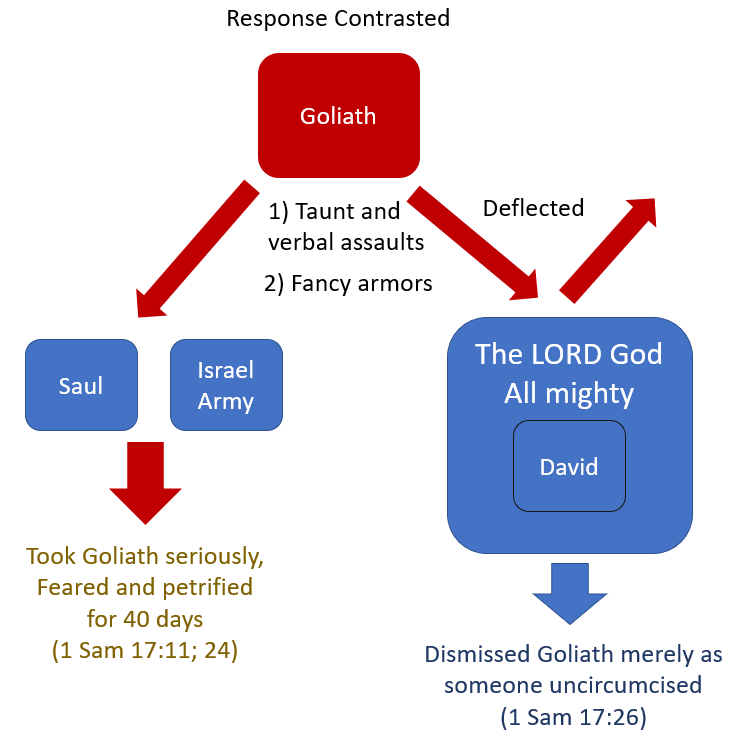
David’s victory against Goliath is frequently considered a huge surprise, or upset, or stunning event. However, an objective assessment tells that David’s victory was not a surprise. David fought and killed stronger, nimbler enemies, such as lions and bears. David brought a projectile weapon that could travel faster than 34 meters per second, a force enough to crack the human skull. Plus, ultimately, David had the LORD God on his side. In contrast, Goliath expected a conventional one-on-one battle using sword or spear. Besides, he was “backed by” his false god, Dagon, which was no help at all. David’s win was not to be a surprise.

Summary

David expressed his desire to fight Goliath the Philistine and was brought before Saul. Saul worried that David was not adequate to fight the Philistine. However, David recounted his past victories against bears and lions and convinced Saul that the LORD who delivered him from the paw of the lion and bear would deliver him from the hand of this Philistine. 

Instead of equipping himself with Saul’s armor, helmet and sword, David took five smooth stones, a sling, and a stick to face the Philistine and declared that he came in the name of the LORD God Almighty. David ran quickly toward the battle line and slung the stone to strike the Philistine on his forehead. The Philistine fell on his face to the ground. Thus, David prevailed over the Philistine with a sling and a stone. For the final blow, David drew out the sword of the Philistine to cut off his head. 

With the death of their champion, the Philistine army fled, and the men of Israel and Judah pursued them as far as to the gates of Ekron, slaughtering them and plundering their camps. 

Prudent in Speech: Encouragement to His Fellow Armies

Back in chapter 16 of 1 Samuel, David was reputed to “be prudent in speech (1 Samuel 16:18).” Being a prudent speaker does not necessarily mean eloquence in speaking. Being prudent in speech means speaking in apt time to give hope and encouragement to his people.

For 40 days, no warrior volunteered to fight Goliath to relieve Saul, who was overcome by fear. “Like a cold water to a weary soul, so is good news from a distant land (Prov 25:25),” David presented himself before Saul. He must have been the first volunteer in 40 days, encouraging Saul by saying “Let no man’s heart fail on account of him; your servant will go and fight with this Philistine (1 Samuel 17:32).” David’s encouragement to Saul was not mere words. He knew that he could fight the Philistine and win. 

Prudent in Speech: Testimony of Past Victories in the LORD God

When Saul expressed his doubt and worries when David voiced his intention to fight Goliath, David reassured Saul that he could win against the Philistine. He began the reassurance process by sharing his victorious testimony in the LORD God Almighty as a shepherd. David gave his testimony for two major purposes: 1) to dislodge the fear of Saul and Israel with God’s courage and perspective; and 2) to declare war against his external enemies, the Philistines.

First, David told Saul that fought against and killed both lions and bears, stronger and swifter enemies. Therefore, David logically concluded that he could kill the Philistine. David’s testimony to Saul highlighted his faithfulness as a shepherd, a responsibility given by the LORD God. To be a good shepherd, he needed to fend off predators, such as the lion and bear. He must have undergone numerous occasions of life-death situations while protecting his flock and sheep. He had to draw closer to the LORD as he faithfully shepherded his flock and sheep because his life was at stake at numerous times. Therefore, as a shepherd, he must have continued to hone his skills to the utmost of his ability to become one of the “best” in the nation – to the level of having a lethal slingshot to repel and even kill formidable predators. He could have decided to stay as a mediocre shepherd, letting go of his sheep when lions and bears attacked, rationalizing that his life was more valuable than a single sheep. However, through that faithful process of doing his best in his occupation as a shepherd, he became a veteran warrior at a very young age around 16. Above all, although he became a mighty warrior, he confessed that it was the LORD God delivered him from the paws of the lion and the bear. His faithfulness to the shepherd occupation must have been part of the heart of man that the LORD looks at (1 Samuel 16:7). 

In addition, David may have learned how to play lyre in order to express his gratitude and praise to God because God saved him numerous times from pierce predator animals. David, in gratitude for being saved by God, used lyre to sing praises to the lord.  Before God, he was a worship leader in lyre. To the flock of sheep, he was a gentle shepherd. Against the lions and other beasts, however, he was a fierce warrior. 

This was his testimony before Saul. Either convinced by David’s testimony or giving up, Saul allowed David to go and fight the Philistine. 

Prudent in Speech: Declaration of War against Enemies 

“Every Battle Is Won Before It Is Ever Fought” 

Sun Zu

Note that David ran quickly toward the battle line to meet the Philistine when the Philistine drew near to meet David. He showed no fear whatsoever to the Philistine, who was of enormous size. This proactive stance in the battle must have been a product of what David learned from his numerous fights against lions and bears. Having fought against these predators, he knew that he had to confront them head-on. Running away or showing his back to these predators would be equivalent to a death sentence. 

David brought his testimony against the Philistine. This version of David’s testimony was different from that was given to Saul. A quick summary of the testimony to the Philistine is this: “I come to you in the name of the LORD Almighty, whom you taunted. I will kill you and remove your head. All the earth may know that there is God in Israel and the battle is the LORD’s.”

David’s testimony in the LORD God was incredibly “cruel” and offensive. Yet, his anger was probably justified because the Philistine taunted the name of the LORD God. He used his sling to strike the Philistine on his forehead. After the Philistine fell on his face to the ground, David used the sword of the Philistine to remove his head. David indeed delivered his testimony.

David’s victory against Goliath is frequently considered a huge surprise, or an upset, or a stunning event. However, objective assessment shows that David’s victory was not a surprise. David fought and killed stronger, nimbler enemies, such as lions and bears as his testimony to Saul indicated. David brought a projectile weapon that could travel faster than 34 meters per second (70+ mph), which has enough force to penetrate the human skull. On the other hand, Goliath relied on conventional one-on-one fighting using a sword or a spear. Plus, ultimately, David had the LORD God on his side. His win against the Philistine was not an upset. He knew he could win based on his past experience fighting against predators with the help of his God. God knew that David would win. The “only” surprised people were the Israel army and the Philistines. 

Meaning of Humility Revisited 

David’s stepping out to volunteer himself to fight the Philistine was an ultimate sign of humility. Humility is expressed when we make the most of our ability – given by God – to serve others. In this particular situation where Israel was facing the Philistines in the battlefield, David accurately assessed his winning odds against the Philistine and brought a morale-boosting victory to his fellow Israelites. 

What if David stayed quiet, unwilling to manifest himself to fight the Philistine (which would have been a false humility)? Israel would have continued to fear and eventually lost this battle. 

Israel Victorious, but…

David’s killing of the Philistine raised morale for Israel to give them a resounding victory. However, the army of Israel plundered the camp of the Philistine (1 Samuel 17:53). Plundering itself is a usual activity during the battles in the days of ancient Israel. However, the author used the word “Šāsas,” which has some negative connotation of the plundering activities. This plundering of the Philistine camp by the Israelites may not have been pleasing to the sight of the LORD – unlike the plundering (Nāṣal) of Egypt when the LORD brought the Israelites out of them (Exodus 12:6). 

What God may have wanted Saul and the Israel army to do was to chase the Philistines to defeat them more thoroughly as this was the original mission given to Saul by God (1 Samuel 9:6). It was possible that the Israel army was distracted and placed more of their effort plundering the Philistines’ material than the Philistines themselves. Later, Saul and sons of Saul were killed by the Philistines (1 Samuel 31). 

Victory that should point to the LORD God 

Young David was incredible in his victory. He was a faithful shepherd, and as a shepherd he honed his projectile weapon skill to the pinnacle level to be a mighty warrior. However, let’s not forget that this victory should point to God. 

Before the actual fight, David and the Philistine exchange a clash of worldview. The Philistine came with sword, spear, and javelin whereas David declared that he came in the name of the LORD and all the earth would know that God resided in Israel. 

David acknowledged that it was God who delivered him numerous times, not the skill of his slingshot, in his shepherding job. It was God who gave courage to David. It was God who gave David a victory. David had to use just a single slingshot to kill the Philistine. Although David achieved this great victory, we have to remember that this was God.

Application

David’s faithfulness to God through his occupation as a shepherd is noteworthy. David met the LORD his God as he was faithfully doing his job as a shepherd. This is something that we, especially as laymen, could learn. Have we encountered God through our profession and in our daily tasks?

What is your testimony? Let’s recount our victories in the LORD and let those be our testimony.
1 Samuel 17:1-30: Fear and Eighty “Psalms” of Goliath

Fear is contagious and can be powerful. It can be amplified to petrify the entire national army for 40 days. However, those who are rooted in the covenant of the LORD can reject that kind of fear.

Summary

The camp of Israel and Philistines gathered at the opposite side of the Valley. Goliath, a heavily-armored Philistine of more than 9 feet tall, provoked the army of Israel and instilled fear into the heart of Saul and the entire Israelites. The entire Israelite army continued to be petrified for 40 days as the taunt of the Philistine continued. 

David came to the camp to provide supplies to his brothers, who were among the armies. He heard the taunting of the Philistine and became indignant. 

Contagious Fear

Who was the natural person to lead the Israel army when Goliath, the Philistine, taunted and defied them? That would be Saul himself. Not only was he the king, but he was also a very tall person as well. King Saul may not have been as tall as Goliath, but he was described as a head taller than the rest of the Israelites (1 Sam 10:23). 

His leadership greatly mattered. Yet, he fell into fear (17:11), and that was not good. When a leader fell into fear, the effect of fear would amplify to his/her followers. Therefore, the entire Israel greatly feared and was dismayed. 

Source of Fear

Although Saul was the legitimate, appropriate choice to fight Goliath one-on-one, he did not have to fight Goliath himself. It would not be rational to send a king to fight one-on-one battle. However, King Saul had no reason to fear Goliath, either. 

Then, what was the source of the fear? The primary source of fear was the absence of the Lord God in the heart and mind of Saul and the entire nation of Israel. 

As Saul disobeyed the word of the Lord, Saul was rejected being king (15:23). The Spirit of the LORD was no longer with Saul. Without the protection of the LORD God, Saul was vulnerable to succumbing under fear. Also, this was the time of Judges (1 Samuel 1:3) during which people did whatever they saw fit and they showed no honor to God. The Spirit of the LORD was absent in the top national leader, Saul, and in Israel as a nation had little fear of God. In the absence of the fear of the LORD God, something would fill that void. That would be the fear of men. Saul and the Israel army allowed the fear of men, in this case, Goliath, to fill the void created by the absence of the fear of God.

The secondary reason for fear was the wrong focus. Note that the author intentionally described the details of Goliath’s armor, helmet, shield, and spear to highlight the splendor of them (17:4-7). Their combined weight was estimated to be more than 60lb. Saul and the Israel army allowed their vision to be captivated by the splendid armor and weapons and their ears to be captured by the taunts of Goliath. The fear that started with Saul spread to the rest of the Israel army. 

Solidification of Fear: Goliath’s Eighty “Psalms”

Although the fear was contagious, it could have been contained early. However, Saul and Israel allowed the fear to solidify. 

The Israel army allowed and yielded an open forum, the valley of Elah, to Goliath for the opening of his insults and mockery of the LORD God and the Israelites army freely. For the next forty days, in the morning and evening, the Philistine would come out to taunt the living God and defy the Israelites. Given that he did this twice a day, his taunt went on for eighty times, which continued to assault the mentality and spirits of the Israel army. As sound travels upward, his morning and evening taunt traveled upward and transmitted to both the Philistines and the Israelites: a booster effect on the Philistines and debilitating effect on the Israelites. 

By listening to the eighty “psalms” of Goliath, the fear of Saul and the Israel army was cemented day by day, to a point of no recovery: they fled from Goliath and were greatly afraid (17:24). Because they allowed the message of the Philistine to form and cement their fear, Israel had no chance. 

Fear Repelled: Identity in the Covenant of the Lord God

While Saul and the entire Israel were under fear, David came to the battlefield unaffected by their fear. When he heard the 81st “psalm “of Goliath, he responded very differently from Saul and all Israel. 

Unlike Saul, David showed himself to have a firm identity in the LORD and under His covenant. He dismissed Goliath as merely someone who was uncircumcised (17:26). To David, the enormous and splendid armor and weapons were invisible, and instead he focused this battle from the perspective of God’s covenant. Then, David possibly spotted the major weaknesses of Goliath, his mobility and his large surface area. Given that he was a very tall man, his shield bearer was not able to cover his face, which David might have seen as an opening for his slingshot. With this focus, instead of allowing external visual and hearing inputs to dictate his perspective, David stayed firm within God’s truth to set his thought and perspective straight against Goliath.

What to do with fear?

Fear is powerful. However, God is far more powerful. Almost all Israel succumbed to fear when Goliath taunted and defied them. However, David had his identity firmly rooted in the LORD God to assess the overall situation from God’s perspective. He simply rejected it.

Do not let fear dictate your thoughts. Do not let fear take the open forum. Instead, squash it with your identity in the LORD God as David did.

1 Samuel 16 Part 2 (16:14-23): David the Polymath, a Man After God’s Heart

Summary

Meanwhile, the Spirit of the LORD departed from Saul, and he was being terrorized by an evil spirit. Saul’s servants recommended that he brought David, a skillful musician, a mighty warrior, and a man of God to sooth his terror from an evil spirit. David was brought before Saul, and whenever the evil spirit tormented Saul, David would play the harp to refresh and soothe Saul. Saul loved David greatly.

Identity in the Spirit of the LORD

The name David means “beloved.” Indeed, he was the beloved man of God.

Notice that the name David does not appear until the arrival of the Spirit of the LORD mightily upon him. Before that, he was referred to as the youngest who was tending the sheep (16:11). Even after he was brought in, only the descriptions of him were given – ruddy with beautiful eyes and a handsome appearance (16:12). The Lord confirmed that he was the anointed one. Only after the mighty coming of the Spirit of the LORD, his full identity – David – was revealed to the readers (16:13).

David’s Reputation

Although only a young shepherd, David already earned a reputation as a man of God. One of Saul’s servants described David as “a skillful musician, a mighty man of valor, warrior, one prducent in speech, and a handsome man; and the Lord is with him (16:18).” 

Where did this reputation come from? We can trace his reputation back to that of Ruth, his great-grandmother. In the book of Ruth, Boaz was already aware of Ruth’s reputation: the kindness that Ruth demonstrated for her mother-in-law after the death of her husband and the courage to leave her people, the Moabites, to come to join the people of God (Ruth 2:11). Boaz stated that “all my people in the city know that you are a woman of excellence (Ruth 3:11).” Ruth was recognized as a woman of excellence by her godly respect of her mother in law, late husband, the LORD’s people, and her diligent work ethic.

From a godly great-grandmother Ruth came David. He demonstrated a similar set of godly attributes, and he became well-known, even to a young servant of Saul. Although a widow and a shepherd, they let their light shine before people as Jesus said of his followers: “You are the light of the world… let your light shine before men in such a way that they may see your good works, and glorify your Father who is in heaven (Matthew 5:14-16)”

David the Meek Polymath

Some of the well-known descriptors of David include the following: David the shepherd, David the man after God’s own heart, David the slingshotter, David the sinner, etc. However, I would like to give him a new descriptor from a new perspective: David the Polymath

Polymath: An individual whose knowledge spans a substantial number of subjects, known to draw on complex bodies of knowledge to solve specific problems (wikipedia)

The importance of polymath is not necessarily the variety of expertises, but the ability to maintain a humble posture to be teachable and learn new things in order to connect a variety of subjects that are seemingly unconnectable. David was a polymath – skillful in multi-disciplines. Being a polymath probably allowed David to experience God from a variety of angles.

David was described as “a skillful musician, a mighty man of valor, warrior, one prducent in speech, and a handsome man; and the Lord is with him (16:18).” He was a skillful musician – his softside to sooth other people from anxiety and his main tool to worship the LORD God. On the other hand, he was a fierce, mighty warrior. When the time required him to protect his flock and sheep from predators like lions and bears, he was fierce, putting his life to protect them. Finally, he was prudent in speech. What does it mean by being prudent in speech? Not the eloquence, but the use of speech in Psalms and hymns to encourage and give life to people around him and vertically honor and worship the LORD God. In other words, being prudent in speech is equivalent to loving God and loving your neighbor.

These attributes demonstrate that David was meek: power under control. David used his power, slingshot, to protect the weak, his flock and sheep, from the fierce enemies, lions and bears. Jesus was the most meek person. Jesus, the most powerful “person,” used His power to protect and save the weak, us, from the ultimate power of the enemy, the eternal death.

David served Saul

Multi-talented David served Saul. Whenever Saul was under torment, David would play the harp to help Saul overcome the evil spirit (1 Samuel 16). David, who was full of the Spirit of God, could have looked down on King Saul, who was under torment from the evil spirit. In addition, David knew that he was anointed by Sameul, a more reason not to serve King Saul with all of his heart. David could have fallen to a trap of self-righteousness over King Saul. However, David faithfully used his musical talent to sooth King Saul’s pain. David probably used his musical talent and harp to praise God, and the invitation of presence of God allowed King Saul to withstand the torment from the evil spirit.

Conclusion

David found his identity in the Spirit of the LORD. David’s multiple talents allowed him to experience God from a variety of ways. David used his talents to serve those who were in need.

1 Samuel 16 Part I (16:1-13): Covert Operation by the LORD God and Samuel

King Saul was rejected. Prophet Samuel was dejected. But, the LORD God selected. Despite Saul’s failure as king of Israel, the LORD continued to work out His redemptive plan – with Samuel through David, and eventually to Christ.

Recap of 1 Samuel 16:1-13

The Lord told Samuel to overcome his grief over Saul and go down to Bethlehem to anoint a king that the LORD Himself had selected, one among the sons of Jesse. Samuel obeyed promptly and went down from Ramah to Bethlehem to anoint the one that the LORD had selected. Jesse made seven of his sons pass before Samuel, but none of them were selected. Finally, the youngest son was brought in, and the LORD indicated that he was the selected person. Samuel anointed him, and the Spirit of the LORD came mightily upon David. 

The LORD God is active

One of the key words in the first half of the chapter is “for Myself.” God chose a king for Himself. Previously, the LORD allowed the people of Israel to choose their king. In accordance with their desire, value, and criteria, Saul was chosen as king (1 Samuel 8-10). Saul was the king that reflected the desire of the people of Israel to become like other nations. Because Saul’s heart was not completely devoted to the LORD God, he failed and God subsequently rejected him. 

However,  the LORD continues to work out His plan even when man fails. He rose up and by working with an individual who feared Him, such as Samuel, the LORD chose the king to continue to further His redemptive plan. 

Macro Perspective: Book of Judges vs. Book of Ruth 

1 Samuel 16 depicts a major turning point for the nation of Israel and more broadly, a redemptive plan of God for man. In some way, 1 Samuel 16 directly follows the book of Ruth with two main connections: Bethlehem and David. In the book of Ruth, the redemption took place in Bethlehem and ended with the introduction of David in the genealogy that includes Boaz and Ruth. 1 Samuel 16 brings back both Bethlehem and David to be connected to the book of Ruth. In contrast, previous chapters in 1 Samuel (from 1 to 15) are continuation of the book of Judges 

The book of Judges vividly depicts how far the people of God can fall away: everyone did what was right in his own eyes (Judges 21:25). The book describes national-scale massacre and oppression of the weak (Judges 21), corrupt worship system (Judges 17), fallen priests (Judges 19), and powerless people of God against adversaries. Despite their calling to be the people of God to be the light and hope for other nations, they failed to heed the LORD’s words and commandments. They followed the way of other nations by worshiping false gods and oppressing their fellow brothers and sisters. 

Likewise, 1 Samuel starts with little changes from the periods of Judges – the word from the LORD was rare and visions were infrequent (1 Samuel 3:1). Why? Because the Israelites deliberately ignored the word of God, the LORD God stopped speaking to them – conversation is a two-way communication. Even the high priest at that time, Eli, failed to heed and listen to the LORD God. Eli was the high priest that was the byproduct from the anemic spiritual conditions during the period of Judges.

Yet, in contrast with the book of Judges, the book of Ruth was where the promise of God and His redemptive plan reignited – from a relatively invisible city of Bethlehem. The event started with two widows, Naomi and Ruth: the people in the lowest economic ladder. However, Ruth demonstrated loving-kindness (hesed) to Naomi, her mother-in-law, and to the dead husband, and came to join the people of God in Bethlehem for love of the LORD God. Ruth proved herself to be a woman of God, and Boaz, a man of God, redeemed the family of Naomi by marrying Ruth. After a few generations, David was born from this genealogy. 

Micro Perspective: Intimate, Covert Operation 

The whole content of the text, 1 Samuel 16:1-13, signifies the intimate, close relation between the LORD God and Samuel. Both were on a secret, stealth mission to anoint a new, future king for Israel, who would eventually be a physical ancestor of Christ. Given that this was an incredibly important mission, we can see that the LORD God trusted Samuel and the LORD God loves to work with His people. 

By the way, why did this mission have to be stealthy, secretive?

First, there was a practical reason: to protect Samuel from Saul. See how Samuel responded to the LORD’s command in honesty and in worries that Saul might kill him if Saul found out that Samuel went down to Bethlehem to anoint a new king (16:2). The LORD provided a solution to disguise this trip to Bethlehem as a peace offering event. The LORD God heard and empathized with Samuel’s concern to provide him with a wise tactic. Just as the LORD did with Samuel, God does hear our concerns to give us a wise solution. 

Second, the stealthy nature of this anointing mission aligned well with the character of God, especially associated with the way He works out His plan. Let’s go back to the book of Ruth and the book of Judges. The book of Judges was filled with visible, national headline events: national wars, civil wars, gruesome death of a concubine and her chopped body, etc. Notwithstanding these national-scale events and battles, God’s verdict on the people of Israel was that everyone did as they saw fit with little reverence to God and His work. In contrast, the book of Ruth depicts the work of the LORD God that started in a small town of Bethlehem with two helpless widows. His firm, redemptive plan was stealth and invisible, but firm and unstoppable in the book of Ruth. Likewise, the work of the Lord for selecting the next king, whose heart was aligned with Him, was stealth as it was conducted primarily by the man of God and the LORD on one-on-one basis. 

Imagine how cool it would be to have this secret mission with the LORD God based on an intimate personal relation. Contrast this with Eli, the previous high priest who preceded Samuel. There was rarely any vision from the lord to the Israelites (1 Samuel 3:1). Eli refused to listen to God and honored his sons more than he honored God (1 Samuel 2:29). The only significant message from the LORD God on Eli was a severe judgment (1 Samuel 2:32-36)). On the other hand, the LORD partnered with Samuel to complete this secret, stealthy mission of finding and anointing David. Samuel took the risk and quickly obeyed. 

Lesson for Samuel, a Man of God

The LORD God did not reveal everything about anointing the next king to Samuel. He led Samuel little by little. First, the LORD revealed that it would be among the sons of Jesse. Even after going through seven sons of Jesse, the LORD told Samuel that none of them were selected. Even Samuel had to go through this process. What was the lesson that the LORD wanted Samuel to learn? 

“…for God sees not as man sees, for man looks at the outward appearance, but the Lord looks at the heart”

1 Samuel 16:7 NASB

Let’s note that this was spoken to Samuel by the LORD God. Samuel was already a man of God, and he walked with God for many years since he was a child (1 Samuel 3). Yet, even Samuel was prone to be impressed by the appearance and the stature of a man. Even Samuel needed God’s direct message to stay alert to perceive the inner heart of man instead of being impressed by the appearance of man. 

Conclusion

This passage can be looked at from a macro and micro perspective. From a macro perspective, we see God continues to work out His plan, which may be stealthy and covert, but would not stop. From a micro perspective, we see that God works with His person (or people) intimately and through this process, He wants His people to learn a valuable lesson.  

I pray that every follower of Christ will have this kind of amazing opportunity to work with God that becomes an integral part of His macro work of redemptive plan.

The Worldview of “Give us this day our daily bread”

“Give us this day our daily bread.”

‭‭Matthew‬ ‭6:11‬ ‭NASB1995‬‬

We are very familiar with this verse. This is a verse that is routinely included in daily prayers of many followers of Christ. Within the LORD’s prayer, this is the first verse of supplication. Yet, embedded in this simple supplication is the guidepost for many aspects of our lives. Let’s uncover three important principles embedded in this supplication of “give us this day our daily bread.”

True Source

This is an amazing prayer. Jesus, being equal and existed in the form of almighty God, laid out His humble request of asking for basic necessity of daily bread, from His heavenly Father. Let this sink in for a little bit. 

Jesus had no need to lay out His daily bread request to the Father. Jesus multiplied a few loaf of bread and fish enough to feed 5,000+ people. 

Jesus did this to demonstrate a very important point to His disciples. The true source of every thing is the Father. If the absolute basic necessity required for survival (which was expressed as “daily bread”) comes from the Father in Heaven, then wouldn’t everything else that is considered beyond the basic necessity would have to come from God as well?

Embedded in this prayer is the acknowledgement of God the Father as a true source of everything.

Let us acknowledge the God the Father as the true source of our daily bread. However competent you are or competent you may feel, let’s acknowledge that daily, the most fundamental unit for human’s physical survival, comes from the heavenly Father.

Contentment

Give us today our daily bread shows Jesus asked for people’s needs not people’s wants. A realm of necessity and a realm of enjoying the surplus are different. 

God is not necessarily against endowing His people with surplus blessings, those that are beyond the necessity. However, at the same time, God knows that too much surplus blessing tends to corrupt the condition of the heart to serve money instead of the LORD.

Therefore, let’s pray for our daily bread with the focus on the need. Let the surplus blessing be in the realm of God’s decision. If God were to shower us with surplus blessings (whether be wealth, occupational title, relation, family, etc.), then let us also pray that our heart and mind would be mature enough to stay within the fear of the LORD not to be carried away.

Community

Give US OUR daily bread. Jesus did not say, “Give me my daily bread.” Plural form of us is to be used for all the followers of Christ in His prayer the Father in Heaven.

Implicitly included in this prayer is the importance of community. We ask for our daily bread, not just for me, but for us. 

God commanded the Israelites not to neglect the weak and poor of society. Specifically, God commanded the first and second generation Israelites to ensure that in the harvest time, they should not reap every corner of the field, but to leave gleanings for the widows, orphans, and aliens (Leviticus 19:9-10, Deuteronomy 24:9). God desired to provide bread to all, and especially for the needy. God wanted those who were blessed with abundant wealth to share with others.

Let this be one of the prayer lines that forge our worldview and conduct of everyday living.

Source: Korean Central Presbyterian Church Young Adult Service on June 13, 20210

Numbers 9: Beautiful Scene of Obedience

Chapters 9 and 10 of Numbers record rare incidents of full obedience of the Israelites. Some people were longing to participate in worshiping God. The entire Israelites followed the LORD’s direction in camping and setting out. We also see a “continuous” presence of God, which reflects His faithfulness and steadfastness. 

Summary

In the wilderness of Sinai, in the first month of the second year after they had come out of the land of Egypt, the LORD spoke to Moses to command the Israelites to observe the Passover. 

The sons of Israel observed their first Passover since they had come out of the land of Egypt. Those that were clean observed the Passover at the appointed time on the fourteenth day of the first month. About a month later, those who were unclean because of the dead person observed the Passover in the second month on the fourteenth day at twilight. However, those who were clean but deliberately neglected to observe the Passover shall be cut off from the people, the LORD commanded. 

Since the day the tabernacle was erected, the LORD led the Israelites by the cloud and the pillar of fire.The Israelites kept the LORD’s charge, according to the command of the LORD through Moses.

Proactive Participation

How much do we yearn to participate in the fellowship with and worship of the LORD? I believe there is an important lesson for us from these men who were initially not allowed to participate in the Passover because of their previous contact with a dead body. 

The initial rule on the Passover was that those who were unclean (i.e. through touching a dead body) were not allowed to participate in the Passover. However, this initial rule would not deter certain men who were unclean from raising their honest voice and expressing their desire to participate in the Passover, a great event associated with God’s miraculous deliverance of His people. 

Note their proactiveness and desire to participate in the Passover. For those who despised the Passover, they could have taken this excuse not to participate in the Passover. However, they showed proactiveness and their uncleanness would not deter them from participating in the Passover (Numbers 9:6-7). These men came to Moses and Aaron and politely raised their voice that their exclusion from the Passover was unfair – a fair point because they could have experienced death within their extended family, which was outside of their control.

Moses, being a humble leader, asked (Numbers 9:8) the LORD for His guidance. God the LORD, who listens to our every prayer and request, responded in a fair manner (Numbers 9:9-14). God provided a solution and clarified the Passover. God told them to keep the Passover a month later. Then, God clarified that the Passover participation encompassed both the native and sojourners.  

Because of their proactiveness to participate in the LORD’s Passover, the LORD God gave them a solution and also clarified the scope of the Passover.

Let’s be proactive in participating in the fellowship with and the worship of our God!

Majestic Scene and Intricate Care: Cloud and Fire

After the Passover was kept by the Israelites in their full obedience, God manifested Himself through the cloud on the day and the appearance of fire in the evening (Numbers 9:15)

Source: https://tcf-spain.org/sermons/the-pillar-of-cloud-and-the-pillar-of-fire/

Imagine this majestic scene of fire as if you were a young child with your family at night. This was not just the majestic scene. In the wilderness, it was dry on the day and on the night the temperature dropped precipitously. The cloud on the day surrounded God’s people with coolness and moisture in the dry and weary land of wilderness. Pillars of fire at night provided warmer temperatures to dampen the effect of a plummeting temperature. In the majestic scene of God was the intricate care for His people. He provided a cozy climate for His people as if an eagle carried its young (Exodus 19:14).

Continuously

So it was continuously; the cloud would cover it by day, and the appearance of fire by night

Numbers 9:16

The word “continuously” stood out. This term rhymes well with one of the key characteristics of God: His steadfastness. 

God led His people steadfastly and continuously with protection whether the Israelites were aware of or not. Even when they were not aware of God’s presence, God continuously protected and led His people. 

Likewise, God has led and protected you continuously even if you were unaware of it. Let this sink in. 

Father Heart of God

There seems to be a lot of redundancies from Numbers 9:18 to 9:23, which can be summarized into a single sentence: At the command of the LORD they camped and set out. Then, why was the main point repeated multiple times, although these verses were saying essentially explaining the same action by the Israelites?

I believe this was the reflection of the Father Heart of God on His beloved children, the Israelites. Moses was pleased to see the Israelites fully obeying the direction of God provided by the cloud and fire in camping and setting out. God also was pleased (perhaps, overwhelmed with joy) when they fully obeyed. It is like a father recording all the actions of his children whom he deeply loves. God wanted this to be vividly, repeatedly expressed to be imprinted in His heart, and also to let everyone know this.

Numbers 8: A Living Sacrifice Holy to the LORD

It is important to dedicate yourself to the LORD both privately and publicly. It is important to dedicate yourself to the LORD in your prime life. It is also important to dedicate yourself, along with others, as a unified body of Christ to the LORD. These are the main lessons from the dedication of the Levite tribe to the LORD in Numbers 8.

Summary

The LORD spoke to Moses to speak to Aaron to set up the seven lamps in front of the lampstand. Then, the LORD commanded Moses to dedicate the Levites to Him.

Let’s break the chapter down by who, what, where, when, how, and why to draw insights from each element. 

Who

That the entire Isrealites and the LORD participated in this public dedication signified the importance of this unifying event. The main players in this chapter are as follows: the Levites, Moses, Aaron, the entire Israelites, and the LORD. Moses and Aaron helped Levites to be cleansed and be presented to the LORD publically. 

What

The main topic of the chapter is a cleansing of the Levites, followed by a public dedication of the Levites. 

Where

The dedication of the Levites was likely to have taken place in the wilderness of Sinai (Numbers 9:1). 

When

This took place a little bit before the first month of the second year (Numbers 9:10). This means that the cleaning and the dedication took place approximately a little bit less than a year after the first Passover and the crossing of the Red Sea. 

How

The majority of the chapter is devoted to explaining the details of how the Levites were dedicated. The dedication ceremony was both private and public. 

Private purification was the first part of the dedication (Numbers 8:7). The Levites were taken by Moses and they were cleansed by Moses with purifying water. They shaved their whole body and washed their clothes and presented grain and sin offerings privately.  

Public ceremony was the second part of the dedication. This public ceremony was presented before the LORD with the entire Israelites. Note that the entire nation of Israel participated in this ceremony; 

1) The sons of Israelites laid their hands on the Levites; 2) the Levites were presented as a wave offering to the LORD; 3) the Levites laid their hands on the head of the bull for the offering and to make atonement or the Levites; 4) The Levites were offered as a wave offering the second times.

Note that the Levites were offered to the LORD twice as a wave offering. This was how the Levites were wholly given to the LORD and they belonged to the LORD (Numbers 8:16). 

It was the gift of God for the Levites to be wholly dedicated. It was the privilege to perform the service and make atonement for the Levites on behalf of the rest of the Israelites. 

Why

Why were these steps important?

This dedication ceremony was important for the Levites themselves privately and for the Israelites publicly. First, all the detailed steps of dedication were to qualify the Levites to perform the services of the LORD (Numbers 8:11). Second, the Levites were dedicated to make atonement for the entire Israelites so that there would be no plague among the Israelites when they come near the sanctuary (Numbers 8:19). 

In other words, the Levites “sacrificed” themselves so that the rest of the Israelites could worship the LORD near the sanctuary freely. 

Immediate application: are you serving yourself as a bridge for others to be connected to the LORD God? 

Romans 12: A Living Sacrifice (a singular sacrifice, not plural sacrifices)

It is difficult not to draw a comparison between Numbers 8 and Romans 12. Apostle Paul urged Christians in Rome to “present your bodies a living and holy sacrifice, acceptable to God, which is your spiritual service of worship (Romans 12:1).”

The Levites were offered as a wave offering (Numbers 8:13). Note the use of plural and singular in both Numbers and Romans verses. The Levites and your bodies were plural. However, “a wave offering” and “a living sacrifice” were singular. Insight: although we are distinct, separate individuals in Christ, when we were offered to the LORD, we were offered as a single living sacrifice before the LORD.

Dedicate the Best Part of Your Life to the LORD

The Levites were to serve the LORD, starting from 25 and retiring at the age of 50. What was the significance of this? 

Between 25 and 50 can be considered a prime of people’s life. People start to work in their 20s and reach the peak of their work productivity in their 40s and 50s, contributing to the society the most with their labor and knowledge. Likewise, the LORD wanted the Levites’ prime life dedicated to Him. 

Let’s dedicate ourselves as the Levites were dedicated to the LORD!

Numbers 6: Outward Behavior + Inward Heart -> Active Holiness

We often hear that “it’s the heart that matters before God.”

It is true, but let’s be aware of the downside of this statement. 

Summary

The law of the Nazarite was given to the Israelites. The Nazarites were those, men or women, who made a special vow to dedicate themselves to the LORD. The Nazarites were to remain holy to the LORD during all the days of their separation (Numbers 6:8): by abstaining from drinking anything made out of grapes; by having no razor over their head; and by not going near a dead person.

When the days of their separation were fulfilled, they shall bring the offering to the doorway of the tent of meeting. Their offerings were to comprise a burnt offering, sin offering, peace offering, grain offering, and drink offering. The Nazarites shall shave their dedicated head, and the priest would present the offering to the LORD. 

The chapter ended with the LORD’s instruction on how Aaron and his sons were to bless the Israelites. 

The Nazarites and the Levites: Remember the LORD your God

There are some similarities in outward regulations between the Nazarites and the Levites. Therefore, the message and the effect conveyed by the lives of the Nazarites on the Israelite society would have been similar to that of the Levites. 

What was the role of the Levites? The Levites were given a special task by the LORD to be in charge of taking care of and moving all the equipment pertaining to the tabernacle. Three Levite clans, the Kohathites, the Gershonites, and the Meratites, had different roles in overseeing the tabernacle. Therefore, the primary, practical function of the Levite was to set up a tabernacle and move it in a proper manner whenever the Israelite camp was guided to march by the LORD in the wilderness. 

The Levites’ primary, practical function of overseeing the tabernacle  in the wilderness was to transform to a slightly different role of reminding each Israel tribe of the LORD after the LORD gave the land of Canaan to the Israelites. Unlike other tribes, who received their dedicated lots, the presence of the Levites spread out to 48 cities throughout the land of Israel. The presence of the Levites would facilitate the remembrance of the LORD to each Israel tribe by their specially dedicated lives. 

Consider Nazarite in a similar role as the Levite – more at the community level than at the national level. The Nazarites, as those wholly dedicated to the LORD God, would be easy to be recognized as they would have long hair and abstain themselves from any drink made out of grapes. People would be reminded of the LORD in the presence of the Nazarites just as each Israel tribe would be reminded of the LORD by the presence of the Levites.

Consider Nararite not as a regulation, but as an opportunity for non-Levite Israelites to dedicate themselves like priests and live out their full life or a limited period of their lives as priests. Note the inclusivity of this opportunity: both men and women were allowed to dedicate themselves to the LORD (Numbers 6:2). Also, this was strictly voluntary. 

Outward Regulations Matter

It is often said among Christians that “it’s the heart that matters before God.”

This statement is true, but could pose a potential danger if one separates the heart from the outward behavior. As Morpheus in the Matrix movie said “the body cannot live out the mind,” the heart and the outward behavior is not distinct, but one. A heart fully dedicated to the LORD God, but without commensurate outward behavior (not saying that we have to be perfect in our daily lives) dedicated to the LORD God, is not a truly dedicated heart. 

For that reason, a few outward regulations, which may seem outdated, such as abstaining from grape-made drinks, keeping long hair, and staying away from a dead body can actually help the Nazarites to set up their hearts dedicated to the LORD. Some restrictions on the outward behavior can help people to maintain the appropriate posture of the heart. 

What are some restrictions on your behaviors that can help you set up the right posture of the heart before the LORD? 

Active Holiness

At the center of Nazarite life is holiness (Numbers 6:8). The Nazarites were to remain holy to the LORD during all the days of their separation. We know from the text that what the Nazarites were not to do (Numbers 6:1-8), and what the Nazarites were to do at the end of their dedication time (their offering before the LORD and the priests in Numbers 6:13-21)

But what about their daily lives as the Nazarites? What does it mean to live a life of holiness? Does it comprise reading and meditating on the word of God and worshipping Him? Yes, but more. 

Many concrete examples of holiness are given in chapter 19 of Leviticus. The chapter starts by “You shall be holy for I the LORD your God am holy (Leviticus 19:3).” Then, the chapter provides many example holiness: honor your mother and father; in your harvest time, leave the grain and grapes for the needy and for the stranger; you shall not steal falsely; you shall not oppress your neighbor; do not be partial to the poor; you shall have just balances and weights in your business transactions.

If the person who took a vow to be a Nazarite happened to be wealthy, that person was to exercise generosity by leaving grains for the needy during the harvest time. If that person was in business, he/she needed to be honest in business transactions. Inside their family, they need to honor their father and mother even more as they made a vow to be a Nazarite dedicated to the LORD. 

Although not explicitly stated in Numbers 8, the Nazarites were to live out a holy life as stated in Leviticus 19. Holiness is an action, not a status. 

God wants to bless you

The chapter ended with the blessing. The bottom line is that God wanted to bless the Israelites. Being a Nazarite is a blessing and opportunity for the Israelites, especially to the non-Levites, to be close to the LORD God, the very embodiment of life. 

Let this chapter of the law of Nazarite be an opportunity for you to be nearer to the LORD your God.

Numbers 2: God of Formation

“The LORD of hosts” is one of the most repeated descriptions of the LORD God in the Old Testament (more than 260 times). What is the meaning of this expression? The New Living Translation makes the term more explicit: The LORD of Heaven’s Armies. 

Yes, that is right. Although this expression was not used until 1 Samuel 4, the LORD God had been essentially a commander in chief of the Israelites army. This role was very important because the Israelites needed to prepare themselves quickly to conquer the land of Canaan soon. 

Then, what was one of the essential elements of the army to become ready for war? Orderly marching formation: especially in ancient wars, especially in a large army mostly composed of infantry. Numbers 2 describes stationary and marching formations for the sons of Israelites to maintain during their time in the wilderness. 

Summary

The LORD said to Moses and Aaron to arrange the Israelites by tribe around the tent of meeting: east, south, west, and north. Each tribe should hold the banners of their family and station themselves close to their clans and family. On the east side were Judah, Issachar, Zebulun tribes. On the south were Reuben, Simeon, and Gad tribes. On the west were Ephraim, Manasseh, and Benjamin tribes. On the north were Dan, Asher, and Naphtali tribes.

In the center was the tabernacle, which resided in the tent of meeting. This was the formation of the entire Israelites when they encamped and when they set out.

The LORD of Order

Imagine leading a troop of 600,000 men, along with another 2 to 3million civilians. Without a proper order, leading this large group of people may easily succumb to a disorderly chaos. A disorder will be detrimental for the morale of the Israelites and could leave them vulnerable to enemies’ attacks. 

For that reason, God commanded Moses and Aaron to group twelve the Israelites into four directions, surrounding the tabernacle in the middle. In order to maximize cohesiveness within the group, the tribes were to stay with their clan and family. The picture below provides an aerial view of the formation. 

Source: http://www.citycentrechurch.org/home/update-on-this-coming-sunday/

The Purpose of Formation 

There seem to be strategic and tactical reasons to have the formation with the twelve tribes surrounding the tabernacle of the LORD on all four corners. 

First, on a high-level, a formation provides order and discipline. This physical order and discipline in the formation would also contribute to alert mental fortitude for the Israelites to minimize a collective complacent mind set. 

Second, this kind of four-round formation instills a sense of self-confidence for all twelve tribes of Israel. All twelve tribes are approximately equal distance from the tabernacle of the LORD. No single tribe is significantly physically closer to the tabernacle of the LORD than the others. Therefore, this formation maximizes the collective sense of confidence while minimizing any tribal superiority or inferiority. The unity across the twelve tribes would be very important in the battle array. 

Third, the formation provides flexibility. Marching can take place in any direction. For each direction, the leading tribes will be different. If the LORD decides to guide them to the north, the leading tribes would be Dan, Asher, Naphtali. If the LORD directs them to the east, then the leading tribes would be Judah, Isaachar, and Zebulun. This flexibility provides an ample opportunity for each tribe to take a leadership role. In the wilderness, flexibility to change marching direction will be important. Also, the experience and the ability for any tribes to lead the march or battle will be important. 

All of these factors contribute to the higher level of confidence and self-esteem for the Israelites. This would boost the morale for the Israelites in the LORD, which will be an essential element in going out to a battle. 

Finally, an orderly formation sends a clear message to the enemies as well. An orderly formation would send a formidable auro to the enemies, deterring their attacks. On the other hand, imagine a chaotic marching by the Israelites. That would be much more likely to invite attacks by the enemies. 

Always be Ready…. To Fight!

Note that the formation was to be kept when they encamped and when they set out (Numbers 2:34). The formation is to be kept the same for both occasions. While they are stationary or moving, they are to keep the same formation. What does this mean? This implies that the Israelites should always be ready to launch into actions, when needed. 

Conclusion

Does order in any way choke efficiency and freedom of the people? No. In fact, they complement each other. Let’s look at the example of traffic laws. Having a clear set of traffic laws enables drivers to drive freely, safely, and efficiently on the road along with others. Having an order and discipline of the army camp empowers the Israelites to camp and march out to the destination freely, safely, and efficiently to the destination.

Numbers 1: God of Compound Interest Rate

“Compound interest is the eighth wonder of the world. 

If you invest a sum of money at 10 per cent for five years, you will multiply your wealth by 1.6 times.

If you invest your capital at that rate for 10 times as long (50 years), you will not multiply your wealth by 16 times.

You will multiply it by more than 117 times.”

Albert Einstein

What does the first chapter of the book of Numbers have to do with compound interest? And, is there any relation between the wonder of compound interest with one of the key characters of God? 

Summary

The LORD told Moses to take a census of all the congregations of the sons of Israel in the wilderness of Sinai. For the twelve tribes of Israel, their total numbered men were 603,550, who were ready to go out to war (Numbers 1:25). The Levites were not counted among them, but they were appointed over the tabernacle of the testimony. 

God’s Invisible Work 

Between Genesis and Exodus, a time gap of approximately 400 years, we do not know exactly what had happened to the sons of Israel. However, this “silence” section of the Bible implicitly points out how God invisibly worked on His people, the Israelites, to produce wonder. Please refer to the equation below. 

What is the equation solving? For those who are Bible and number savvy may have already recognized each component of the equation. On the left side of the equation, 603,550 is the total number of Israelite men in Numbers. On the right side of the equation, 70 is the total number of Israelite men when Jacob came to Egypt, invited by Joseph (Genesis 46:27, Exodus 1:5). 400 is the approximate number of years it took from 70 people to grow to become 603,550 men from Genesis to Exodus and Numbers. The equation is solving for the average annual population growth that enabled 70 men to be multiplied to 603,500 in 400 years.  

What would be your guess of the annual average population growth if the population of 70 was to grow to 603,550 for the next 400 years? 

It requires only 2.3% a year. 

Most people, especially those who are not familiar with the power of compound interest, are surprised to see such a low number. Just a 2.2% annual growth would be needed for 70 to become 603,550. Year-over-year growth would be too negligible to be noticeable. However, this small growth, when compounded for 400 years, would result in an increase of an astounding factor of 8,622. This is the wonder that Einstein talked about – although his was about the money, a similar logic can be applied to population growth. 

This small yearly growth would be powerfully manifested under two conditions: 1) a long time horizon; and 2) consistency. If this growth rate was disrupted significantly anytime in the 400 years, an increase from 70 to 603,550 would not have been possible. Therein lies one of the key characters of God: His steadfast love and work. 

God’s Steadfast Work

Steadfast: a: firmly fixed in place: IMMOVABLE b: not subject to change

Merriam Webster Dictionary

God worked on the Israelites steadfastly over a long time. He never used His power to multiply the Israelites dramatically in a short period of time. A steadfast working of God and His consistency are two of His main characters. God allowed the Israelites to consistently multiply by protecting them from foreign invasions, pandemic, or any other unexpected natural disaster for the 400 years. In the process, a small, consistent annual growth of 2.3% turned 70 men into 603,500 men. 

Lesson

God works faithfully. The steadfast love of the LORD never ceases. His mercy never ends. He who worked on the Israelites will empower you to accomplish His work through you. 

As God multiplied the sons of Israelites from 70 to 603,500, let Him multiply your faith in Him.