Second Thessalonians: Be Prepared to Stand Firm

Before His crucifixion, Jesus told His disciples, “If the world hates you, you know that it has hated Me before it hated you (John 15:18).” In other words, do not be surprised if the world hates you, followers of Christ.

Faith is an intimate relation between Christ and His followers. Growing faith is an action. Growing faith will be hated by the enemies of God, and associated battles will be inevitable. Therefore, faith must be practiced, trained, and disciplined to stand firm until the end. 

The second letter to the Thessalonians directly and indirectly describes the kinds of battles that the followers of Christ faced, are facing, and will be facing. More importantly, however, the letter highlights the fundamental principles of God that would empower the Thessalonians to withstand those battles. 

Chapter Summary

What kind of attacks do the followers of Christ face? Enemies of God launch multi-pronged attacks on the followers of Christ, especially those who are growing in faith. Apostle Paul’s second letter to the Thessalonians provides a great, vivid example of three kinds of attacks: 1) brute persecutions from the Jews; 2) confusing, disturbing false message of the coming of the Christ; and 3) disorderly lives of some Thessalonians who belong to the church. 

The letter not only describes the attacks, but apostle Paul implicitly counters them by highlighting the principles of God, providing specific commands to the Thessalonian church, and praying for them. 

Each chapter corresponds to different kinds of battle that the Thessalonian church was undergoing. Chapter 1 addresses a situation that pertains to the direct, physical persecution of the Jews in Thessalonica. Chapter 2 depicts a situation where people were confused with false messages. In Chapter 3, Paul urges people to work and concludes with his prayer for the Thessalonian church. 

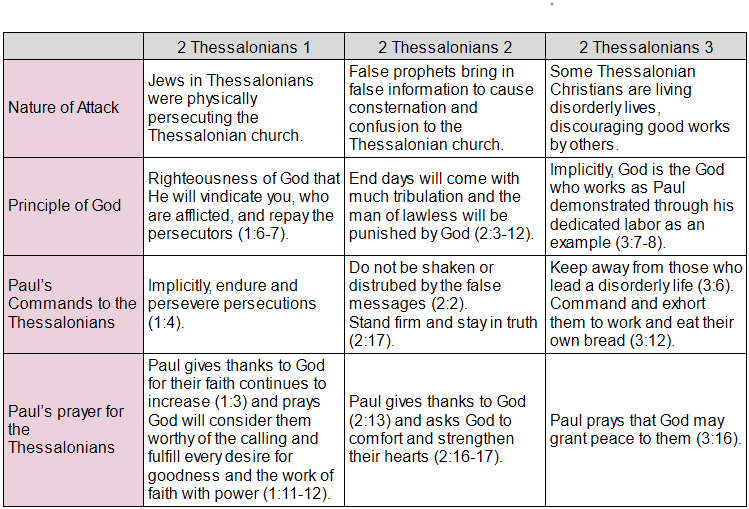
The table below provides a snapshot summary of the entire Second Thessalonians by chapter and criteria. 

In each chapter, the nature of attack on Christians is either explicitly or implicitly stated. In each chapter, Paul encourages the Thessalonians by reminding them of the relevant principle of God and in addition, gives customized commands to withstand the attacks. In each chapter, Paul includes prayers to strengthen them. the main takeaway applicable message is that we fill face attacks, but we have God and prayer to counter them. 

Conclusion

Last Sunday was Easter when we celebrated the victory of Christ. Some of us may be undergoing severe battles as the Thessalonian church did about 2000 years ago. I pray that you will be victorious by reminding yourself of God’s principles and being empowered by prayers of other fellow followers.

1 Thessalonians 2: Agape in the Midst of Fierce Battle

Some of the key repeated concepts in the entire letter of Thessalonians are as follows: hardship, suffering, and trials. None of these terms are popular. However, these were very frequently associated with the advancement of the Gospel and the church. The entire letter of Paul to the Thessalonians revolve around them. Paul, his companions, and the Thessalonian church were in the midst of fierce external and internal battles.

Summary

Apostle Paul states that he came with boldness in God to speak to the Thessalonians about the gospel of God despite a strong opposition from the local Jews. At the same time, Paul and his companions were gentle to the Thessalonians as a nursing mother nurtures her tender child. 

Paul further reminded them that he and his companions labored hard to serve the Thessalonians. Furthermore, Paul also constantly thanked and prayed for them because they received the word of God. Paul complimented them that they became the imitators of the churches of God in Christ despite severe persecution from the Jews. 

For that reason, Paul expressed his strong desire to come and see them because they were Paul’s glory and joy.

Paul’s Boldness in Truth

In all of Paul’s epistles, he showed confidence – confidence in God rooted in the truth of Gospel. He knew that in all his soul and body that he was the messenger with the authority approved by God (1 Thess 2:4 and 2:6). For that reason, he was able to come to the Thessalonians with boldness (1 Thess 2:2), not with flattering speech or a pretext for greed (1 Thess 2:4). 

Jew’s Boldness in Brute Force

On the other hand, let’s contrast the violent behaviors by the Thessalonian Jews with the boldness in truth displayed by Paul. The Jews were bold on the outside, wildly swinging their brute force. They had the power to severely persecute Paul, his companions, and Thessalonians (Acts 16:5, 16:13). However, this persecution by violence was merely an expression of their insecurities.

What were they afraid of? The Jews were afraid of losing their political privilege with a potentially diminished number of followers of the Jewish tradition if they started to follow Christ. The Jews were filled with jealousy because they posited that their exclusivity as the people of God would be tainted by the influx of the Gentiles. To them, protecting their privileges was of utmost importance. Therefore, when the Gospel threatened their prime interests, they became fearful and started to express violence to suppress the truth that Paul and his companions were preaching.

Invoking God’s Wrath

In response to the Jews, Paul had never taken personal vengeance on them. Instead, notice how Paul took this issue to God by invoking His wrath. Paul stated that not only did they fail to please God, but also were working against all humanity (1 Thess 2:15). The accusation that Paul invoked was extremely strong – the Jews were working against all humanity! Why did Paul decide to go this far?

The sin that the Jews were committing was similar to what the serpent did in Genesis 3 by driving a wedge between man and God. The serpent separated man from God by introducing sin to the world. The serpent was “hostile to all people (1 Thess 2:15).” That was what the Thessalonian Jews were doing. Therefore, Paul was making a very strong statement by invoking the wrath of God (1 Thess 2:16). 

Agape >> Fierce External Threats

Despite the persecution by the Thessalonian Jews, the love and longing between Paul and the Thessalonian church continued to grow. Even in the midst of severe persecution, Paul and the Thessalonians started to anchor greater hope in each other in the presence of Lord Jesus.

This is the biblical love. Love that transcends persecution, difficulties, and trials – active love.

1 Thessalonians 1: Receive, Reorient, and Resonate

Receive. Reorient. Resonate. These three terms came to my mind when I read the first chapter of 1 Thessalonians. They received the power. They reoriented their hearts to serve the true and living God. Their influence resonated through the entire region. Paul, Timothy, and Silvanus were extremely thankful and joyful to hear this great message.

Background

Thessalonica was one of the cities that Paul visited during his first missionary trip (Acts 17:1-9). He stayed in the city for three Sabbaths only, after which he had to flee southward due to a severe, violent persecution by the jealous Jews. 

However, the church of the Thessalonians must have been very dear to the heat of Paul, Timothy, and Silvanus. Although the total stay in the city was short, this first letter to Thessalonians showed no shortage of expressed yearning and brotherly love from Paul. What enabled Paul, Timothy, and Silvanus to develop such a strong bond with the Thessalonian church and its saints? Let’s explore this in the five chapters of 1 Thessalonians.

Summary

Paul is giving thanks to the Thessalonians for their work of faith, labor of love, and perseverance of hope. He states that the Gospel came to them in power with full conviction. As a result, the Thesslanians became the imitators of Paul and of the Lord, receiving the word with joy despite ongoing great trials and afflictions. Because of the joy with which they received the word, they became a great example of Christians to all the believers in Macedonia. They also turned to God from idols, served God, and waited for the coming of His Son from heaven. 

Recipient: Church

Very clear and important was the recipient of Paul’s letter: the church of the Thessalonians. Although Paul visited the synagogue of the Jews for three Sabbaths in Thessalonica (Acts 17:1-3), the primary recipient of the letter was the church. 

Then, what is church? As Paul’s main message indicated during the three Sabbaths in the synagogue, church is the assembly of people who profess Jesus as the Christ (Acts 17:2). Although he preached the message to the people at the synagogue at that time, his letter was addressed to the people of Christ, not the people at the synagogue. Again, church is the assembly of people who profess Jesus is the Christ – in other words, Jesus as their master and Lord. 

First Step: Received the Gospel in Word and Power

Paul states that “our gospel did not come to you in word only but also in power and in the Holy Spirit and with full conviction (1 Thess 1:4).” What a statement. Let’s unpack this profound statement by focusing on the two terms, “word,” and “power.” 

The Gospel came in word. Let’s not take this for granted. Why is this important? It is important because words can be understood by finite people like us. It came in words so that the Thessalonians can grasp the love languages of God. In addition, it came with power. The absolute power resides in the Gospel because it unshackles us from the grip of the power of death to eternal life with God. 

The opportunity to receive the Gospel is utterly by the sole grace of God. The Gospel is the most precious gift to mankind. Paul was the messenger to the Thessalonians. That Thessalonians received the Gospel through Paul was by grace. 

Second Step: Reorient and Grow

The Thessalonians received the Gospel in word and power. By seeing Paul’s prayer for them, we can tell three important elements that pertain to the reorientation and growth in Christ (1 Thessalonians 1:2-3). 

  • Work of faith: Faith is a relation with and an utter trust in Christ. Any relation requires sincere work. Paul wanted to include this in prayer so that the church of the Thessalonians continue to work on deepening their relation with Christ. This is not saying that work is required to be saved – this is solely based on the grace of Jesus Christ. However, as faith is an active relation between two entities, it makes sense to use a phrase, “work of faith.”
  • Labor of love: Loving your God and neighbor is not a natural extension of man’s heart and behavior. The world often uses a phrase like “falling in love” as if love is a passive and emotion-driven element. However, biblical love is agape. Love requires labor. It needs to be deliberate and action-oriented. God demonstrated this by persistently chasing the Israelites, His people, by eventually sending Jesus to forgive and save them. Paul wanted the Thessalonians to labor to show love.
  • Perseverance of hope: Reorient your perspective to behold the great glory with Christ in the near future. The church of the Thessalonians was under severe afflictions from the Jews. Therefore, Paul was encouraging them to persevere and look for the future of Christ and His glory.

The Thessalonians seem to be already demonstrating the results of these. As they “turned to God from idols to serve a living and true God, and to wait for His Son from heaven (1 Thess 1:9-10).”

Third Step: Resonation

The Thessalonians had already become influential as they became imitators of Christ and Paul demonstrated joy despite ongoing great trials and afflictions (1 Thessalonians 1:6). This was one of the key attributes that distinguished the genuine followers of Christ from others. Because of the expressed joy, they became a great example of Christians to all the believers in Macedonia. 

So let us pray that we will receive the word of God, let the Holy Spirit reorient our hearts, and let the work of God resonate from us.