2 Samuel 9: Machir Who Showed Loving-kindness

[Jesus said] “The King will answer and say to them, ‘Truly I say to you, to the extent that you did it to one of these brothers of Mine, even the least of them, you did it to Me.’”

‭‭Matthew‬ ‭25‬:‭40‬

This chapter shows a glimpse of how David ruled his people in Israel – by administering justice and righteousness (2 Samuel 8:15). How a society treats the least and weak is a good reflection of the degree of justice and righteousness of that society. In this chapter, David personally reached out to show kindness to Mephibosheth, a grandson of the fallen previous king, when he did not need to.

At the same time, I would like to highlight Machir, a relatively unknown person in the bible, who showed kindness to Mephibosheth before David searched for him. Let’s not overlook what Machir did.

Chapter Summary

David wanted to show kindness to anyone left of the Saul’s household for the sake of Jonathan. Ziba, a former servant of Saul, was summoned, and David found out that son of Jonathan, who was crippled in both feet, was in the household of Machir in Lo-debar, located in the southeast of the Sea of Galilee. 

Mephibosheth, son of Jonathan, son of Saul, came and prostrated before David. David showed kindness to Mephibosheth and reassured that he would be given back the land that used to belong to Saul and be regularly eating at David’s table. David told Ziba to cultivate the land on behalf of Mephibosheth.

David’s Open Meekness

In the previous chapter, David, being empowered by God the LORD, flexed his muscle to defeat  surrounding nations at all four fronts – south, east, west, and north – to make a name for himself and to receive tributes from them. 

On the other hand, this chapter shows David’s kindness extended to one of the weakest and most vulnerable families and persons: a household of the grandson of a fallen king, who was crippled in both feet. Any descendants or relatives of a fallen king were natural targets for elimination from a new king. Plus, he was handicapped. Therefore, politically and physically, he was one of the most vulnerable person in the entire Israel. It is not strange to see that he lived in the very northern city in Israel, Lo-debar, far away from the land of Judah, where the new king David resided.

That person was Mephibosheth, the grandson of late king Saul. David reached out to Mephibosheth to show kindness to have him dine with David regularly and restore his grandfather’s land when he did not need to. God reached out to us to show grace when He did not need to. David kept his word when he made a covenant with Jonathan to treat his descendants with kindness (1 Samuel 20:14-15). God made a covenant with us unilaterally to demonstrate His grace. Here, we see David showing God’s loving-kindness to the most vulnerable person and family in Israel. 

Jesus told His disciples that whatever they did for the least was equal to what they did to Him (Matthew 25:40). That was what David did. What David did must have been an example of how his governing officials should rule and take care of his people  – by administering justice and righteousness. 

David was not alone. We see another relatively unknown person who showed loving-kindness. 

Machir’s Covert Kindness

Although his name was stated only once in this chapter and not much explanation is given other than he was the son of Ammiel, I want to focus on Machir and his character, especially in contrast to that of Ziba. 

Although Ziba was the official servant of Saul, it was Machir who gave practical help to Mephibosheth by showing hospitality and providing shelter for him for many years. Was there a real need or obligation or any benefit associated with taking care of Mephibosheth for Machir’s perspective? Not much. Mephibosheth was a grandson of Saul, a fallen king, who could pose much more liability than benefit for Machir. 

Taking care of Mephibosheth, a grandson of a fallen king, must have posed a great liability with little benefit for Machir, especially in the era of the new king. It was possible that Machir simply regarded Mephibosheth as a broken person in need. Mephibosheth lost both his father and grandfather at the battle of Gilboa (1 Samuel 31). With both of them dead, his royal status plummeted to the level lower than that of an ordinary citizen. Besides, he was crippled. Despite all these factors, Machir undertook a great risk to take Mephibosheth under his protection. Machir had nothing to gain from taking care of Mephibosheth, but he did it in accordance with God’s loving-kindness. In addition, when David and his men were feeling from Absalom with a weary state, Machir was also one of the people who brought food to them in Mahanaim (2 Samuel 17:27-29).

Ziba the Shrewd Wealth Builder

On the other hand, Ziba as a servant of Saul was supposed to be the official caregiver of Mephibosheth. Ziba was “helpful” by informing the location of Mephibosheth to David. However, instead of taking care of Mephibosheth, he seemed to have found a way to enrich himself by having multiple wives, along with many sons and servants (2 Samuel 9:10). It is not exactly possible to know how he enriched himself when the Saul kingdom fell, but we can make an educated guess that he was a shrewd man, who knew how to take advantage of changing political landscape to obtain additional wealth. 

We see more evidence later of his shrewd nature in building his wealth. In 2 Samuel 16, when David was fleeing from his son Absalom, Ziba acted swiftly before Machir and others to aid David with food, but lied to David that Mephibosheth was delighted when David was running away from Absalom. When David heard this, he gave everything that belonged to Mephibosheth to Ziba. Then, Zina prostrated himself before David (2 Samuel 16:1-4) – note that Ziba did not prostrate before David in the first encounter, but only when he was promised for additional wealth. This episode showed that Ziba was a shrewd man, who knew how to grow his wealth by trickery in a turbulent political situation.  It was possible that Ziba could have accumulated his wealth in a similar manner after the fall of King Saul. 

Conclusion

David showed loving-kindness to one of the most vulnerable households in Israel openly: the grandson of Saul. By treating the weak with dignity, he showed a glimpse of what it meant by administering justice and righteousness to the people of Israel. Machir was a hidden hero – who showed compassion to take care of Mephibosheth, which carried a great risk. However, we have people like Ziba, who was a shrewd person in building his wealth by taking advantage of political turmoils. The chapter shows a microcosm of this world – we may have people with genuine hearts to help the weak, but people who are very shrewd in building their wealth. 

Which one would you be?
2 Samuel 8: Overcoming Four-front War and Conquering Kingdoms by Faith

David overcame a four-front war by defeating the Philistines, the Moabites, Hadadezer king of Zoba, Arameans, and the Edomites. The author of Hebrews describes his conquest of these kingdoms as an act of faith.

Summary: 

After God’s promise to build a house for David, David defeated and subdued many surrounding nations, including the Philistines, the Moabites, Hadadezer king of Zoba, Arameans, and the Edomites. Internationally, David defeated the nations on the west, east, north, and south because the Lord helped him to achieve victories wherever he went (2 Sam 8:6 and 14). Domestically, David reigned over all Israel by administering justice and righteousness. 

Non-discriminatorily Defeating Enemies around the Border by Faith 

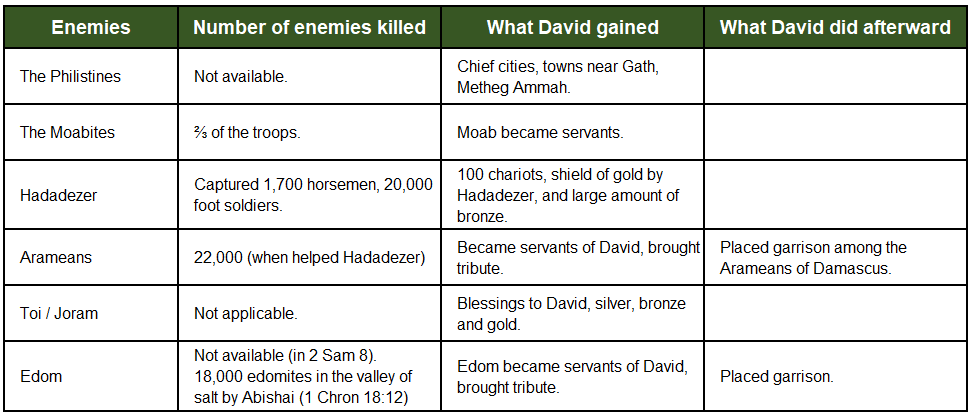
The table below summarizes David’s exploits against his surrounding nations. To the west, he subdued the Philistines and took their major cities. To the east, David defeated the Moabites and they became David’s servant, bringing tributes. To the north, David attacked Hadadezer as well as Arameans, who came to help Hadadezer. David installed a military presence around Damascus. To the south, he defeated the Edomites and they brought tributes to David. 

Table 1: Summary of David’s Exploits against Surrounding Nations

Defeating Enemies by Faith: Fulfilling Promise of 400 year-old

… David  and Samuel and the prophets, who by faith conquered kingdoms, performed acts of righteousness, obtained promises…put foreign armies to flight.

Hebrews 11:32-34

The author of Hebrew makes a statement that it was by faith that David “conquered kingdoms, performed acts of righteousness,” and “put foreign armies to flight.” The statement by the author of Hebrew matches the details of 2 Samuel 8 very well. Then, what does it mean that David conquered kingdoms by faith? I believe David’s actions were considered faith because they were aligned with God’s promises, and David acted in full dependence and partnership with God. 

More specifically, David’s conquest and subjugation of His enemies was in some way an extension of God’s promise and command that would go all the way back to Joshua. God said to Joshua that “Your territory will extend from the desert to Lebanon, and from the great river, the Euphrates — all the Hittite country — to the Mediterranean Sea in the west (Joshua 1:4),” which was much more than the Isrealite territory and includes all the land that belonged to David’s enemies in 2 Samuel 8: Philistines, Moab, Edom, Hadadezer, Arameans, and Hammath. As David ousted the Jebusites to fully conquer Jerusalem to fully claim God’s inheritance, so did David defeated the external enemies around Israel. 

Defeating Enemies by Faith: Overcoming Four-front war

Although we do not know the exact details and timing of these wars (against Philistine, Moab, Aram, Edom), that David was able to defeat his enemies in all four-fronts is noteworthy.

Let’s compare David’s exploits with what Germany tried to do during the first and second world wars. In the first world war, Germany developed a plan to overcome a two-front war risk posed by France to the west and Russia to the east. The Schlieffen plan was to make a swift campaign on the western front to defeat France, then to redirect the troops to the Eastern front to subsequently defeat Russia. The plan failed as the German offensive came to a standstill at the Marne (a river in France) and the Russians mobilized quicker than the Germans envisioned. At the start of the second world war, Germany used blitzkrieg (a term used to describe a method of offensive warfare designed to strike a swift, focused blow at an enemy using mobile, maneuverable forces, including armored tanks and air support) to swept through France, Poland, Norway, Belgium, and Holland and France with astonishing speed and force. However, German forces’ blitzkrieg proved less successful against Soviet defenses, and Germany eventually re-postured itself into a defense war. 

Even formidable German forces  in two world wars were not able to overcome the two-front war. However, David was able to do it – by the power of the LORD his God. Something for us to note in our mind. 

God’s Faith in David: David’s Name to be Great 

It is said David made a name for himself. Was this a statement that David was elevating himself? 

No. Back in 2 Samuel 7, God promised that he would make David’s name great like a great man on the earth. This statement does not indicate that somehow David fell into arrogance, but instead shows a fulfillment of God’s promise to lift up the name of David. 

Defeating Enemies by Faith: Following the LORD’s command wholeheartedly

Another sign of David’s faith in God was how he treated the horses when he captured 1,700 of them. A rational way is to have these stolen horses to be spared and used for future war against adversaries. However, David hamstrung most of the horses (1600 out of 1700) and left only 100 for chariots. When Joshua defeated the Northern coalition forces in Canaan, he also hamstrung their horses and burned their chariots with fire (Joshua 11:9). Likewise, David followed the command of the LORD in Deuteronomy to not rely on chariots or horses (Deuteronomy 17:16), but only on the LORD God for the battle against adversaries. 

Defeating Enemies by Faith: Through Mighty Warriors 

The LORD helped David achieve great victories wherever he went (2 Samuel 8:14). This statement does not necessarily mean that the LORD God gave victories to David in a supernatural way all the time. God often works through people – this time, God provided David through many competent, loyal warriors. 

One of the key reasons for David’s victory was his mighty, loyal warriors. Although 2 Samuel 8 does not describe David’s warriors in detail, 2 Samuel 23:8-36 lists and highlights all the mighty warriors, 37 in total and their exploits. We need to notice that it was not David alone who made these great exploits. These exploits were accomplished with his competent, mighty warriors who were loyal to David. The meaning of the LORD helping David includes the LORD’s empowerment of David through his mighty warriors. God often manifests His power via His people. 

Nation that Administers Justice and Righteousness

While defeating external nations around Israel, David ruled Israel internally by administering justice and righteousness. What does it mean by ruling by administering justice and righteousness? It probably means that David governed the nation by the two major commandments stated in the Law of Moses: 1) loving God; and 2) loving neighbor as yourself. Loving God was reflected in the worship system that David established by organizing the Levites (2 Samuel 6 and 1 Chronicles 15-16). Loving neighbors can be practiced by implementing detailed rules and regulations laid out in the book of Moses (from Exodus to Deuteronomy), which comprises moral, social, and business ethics. One of the concrete commands that practice caring for neighbors is in Leviticus 19:9-10, which states not to gather all the gleaning and not to go over the vineyard a second time to pick up graves. These commands were given to share the wealth that God promises to bless the Israelites in a way to protect the dignity of the poor, widows and orphans. A nation that administers justice and righteousness provides a way for the poor to live while protecting their dignity. 

Be Victorious Christian!

Externally, David defeated the enemies by conquering them. Internally, David administered justice and righteousness to his people. David used the power that the LORD God gave him appropriately. He used power to defeat the external threats and to defend his people. This kind of appropriate use of power is called “meekness.” 

Jesus demonstrated the pinnacle of meekness. For us, He died on the cross to save us. To His enemy, Satan, He crushed its head. Likewise, for those of us, who have power, intellect, wealth, let us use them meekly, in the way in which Jesus and David used. 

2 Samuel 6:20-23: Ominous Sign to David’s Family

David was a man after God’s own heart and he was a genuine worshipper of God. Yet, this passage tragically indicates that he may have been a failing husband based on how Michal responded.

Content Summary

David made the second attempt to bring the ark of God from the house of Obed-edom by assigning the Levites to carry the ark of God. As the ark of God was being brought to Jerusalem, David was dancing and leaping with all his might. On the other hand, Michal despised David who was leaping and dancing, in her heart.

David and Michal: Failure as a Husband?

Being overwhelmed by the joy of bringing the ark of God to Jerusalem, David came to his household to bless them – only to be snubbed and greeted by mockery from one of his wives, Michal, daughter of Saul.

Michal made a mockery of David by saying, “how the king of Israel distinguished himself today! He uncovered himself today in the eyes of his servants’ maids as one of the foolish ones shamelessly uncovers himself!” (‭‭2 Samuel‬ ‭6:20‬) 

On the surface, her contempt of David resulted from David’s overly excessive and unrestrained dancing and leaping with joy. However, this was not likely the primary cause of Michal’s mockery and disdain of David in this passage. Her contempt was likely an expression of multiple complicated factors that attributed to Michal’s explicit disdain of David. 

First, she failed to know the LORD God just as his father did. King Saul did not know the LORD. Likewise, Michal did not know the LORD. Therefore, she simply could not understand the extent of David’s joy, dancing and leaping when the ark of God was brought to Jerusalem.

Second, she might have been bitter that David’s love was divided among the nine wives and other concubines. Before coming back to David, she was a wife of Palitiel, and given that he followed her with tears all the way seemed to indicate that he loved her dearly. Michal was probably receiving 100% of Palitiel’s love (2 Samuel 3:15-16). When she was taken back to David again, she was only one of many wives. She might have felt unfulfilled in this marriage, might have become bitter over time, and started to build resentment toward David. Then, what was in her heart was simply expressed in words of mockery against David. 

This is a bit tragic to see a divisive heart between a husband and a wife. In the Bible record, Michal was the only woman to be in love with David (1 Samuel 18:20). Yet, she came out to disdain David’s worship before God. 

David’s Problem: Too Many Wives and Concubines

“A man shall leave his father and his mother, and be joined to his wife; and they shall become one flesh (Genesis 2:24).” 

Michal’s contempt reveals some of the dark side of David’s family. David was a man after God’s own heart. He was one of the most intimate person with God. He was a great warrior, general, and king. However, in management and leading his household, he did not seem to be a beloved husband (or father as revealed in the later chapters of 2 Samuel). David having too many wives, which God commanded not to do (Deuteronomy 17:17), may have been the root of many heart-wrenching events that broke out later in his life. There is no way for a man to be one flesh with many women. God designed one husband and one wife to be one flesh (Genesis 2:24).

2 Samuel 6:1-19: Pause and Check Your Zeal for the LORD God

Zeal without knowledge can result in a devastating consequence. In his first attempt to bring the ark of God to Jerusalem, David was zealous but had little awareness of the prescribed word of the LORD God about how to properly transport the ark of God. As a result, Uzzah died, and the bringing of the ark of God had to be stopped. In a positive aspect, however, having learned from the first mistake, David made appropriate rectification, and eventually successfully brought the ark of God in his second attempt.

Content Summary 

David gathered all the chosen men of Israel, thirty thousand, to bring the ark of God from Baale-judah (a city located approximately 10 miles west of Jerusalem) to Jerusalem. They placed the ark of God on a new cart from the house of Abinadab, and David, and the house of Israel started to celebrate with all kinds of musical instruments.  

On the way, near the threshing floor of Nacon, Uzzah, one of the escorters of the ark of God, was struck death by the LORD as he reached out and touched the ark of God because the oxen nearly upset it. Being puzzled, David became very afraid of the LORD that day, halted the march to Jerusalem and took the ark of God aside to the house of Obed-edom. The ark of God stayed there for three months. 

David made the second attempt to bring the ark of God from the house of Obed-edom by assigning the Levites to carry the ark of God. As the ark of God was being brought to Jerusalem, David was dancing and leaping with all his might. On the other hand, Michal despised David who was leaping and dancing, in her heart. 

Previous Major Breakthroughs

David underwent God’s breakthroughs both internally and externally in 2 Samuel 5. Internally, David risked and showed his audacity to conquer Jerusalem, the formidable natural fortress occupied by the Jebusites, by launching a sneak attack from the water shaft. Externally, David followed the LORD’s guide to defeat the iron weapon-equipped Philistines – not just once, but twice – who came with a strong intention to shake the foundation of David’s throne over the entire Israel Kingdom. 

Because David conquered Jerusalem, a suitable place to be the capital as it is located in the middle of Israel territory, and repelled external threats posed by the Philistines, he was ready to make his next major move – that is, to establish a worship system of God around the ark of God by bringing it to the capital. 

Ignorance is not Bliss: First Attempt to Bring the Ark of God 

The ark of God resided in the house of Abinadad in the city of Kiriath Jearim (same as Baale-judah) for 20 years since it was returned from the Philistines (1 Samuel 6:21-7:1). David was ready to bring the ark of God because it had not been sought after during the days of Saul. 

Doing the right thing the right way does take patience and a correct understanding of the instruction given by the LORD God, especially related to the ark of God where the presence of God resided. Perhaps a pause to directly inquire of the LORD God was needed for this important task. David made two crucial mistakes, however.

The first mistake was that David did not inquire of the LORD directly about how to transport the ark. It was good that David consulted people regarding bringing the ark of the LORD. It was noble for him to seek the consensus of all Israel about this monumental task of bringing back the ark of the LORD (1 Chronicles 13). However, he failed to consult the most important person – God.

The second mistake was that David did not check the prescribed methods laid out in the book of Moses. The ark of the Lord was to be hand carried by the Levites, specifically the sons of Kohath, using the pole (Exodus 25:13-14). However, it was carried by non-Levites (Ahio and Uzzah are likely to be from the Judah tribe) by using a cart. The idea of a new cart may have been a sincere way to treat the ark of God with reverence, but this was how the Philistines returned the ark of God back to the Israelites when they could no longer endure the powerful judgment by the ark of God (1 Samuel 6:10-11). Only the Levites and the sons of Kohaths were to cover the ark of the LORD and carry – no one was supposed to even see the ark of God. 

Overall, this was a manifestation of collective ignorance of 30,000 people, including David. Among the 30,000 people assembled, some of them were probably from the Levite tribe. However, none of them noticed the wrong way of carrying the ark of God. Indeed, although Israel had some great leaders like Samuel and David, the overall understanding of the law of the LORD (law of Moses) even among the Levite was unacceptably low, not much different from that in the days of the Judges. 

Perhaps, David was too eager and impatient to bring the ark of God to Jerusalem. His desire and sincerity were notable, yet, without proper knowledge and awareness of the holiness of God, the breakout of a disaster appeared to be inevitable.

Mercy of God in Uzzah’s Death 

Uzzah died as he reached out and touched the ark of God to stabilize it. His death may appear to be unfair. He was carrying the ark of God. Plus, his household provided a place for the ark of the LORD for 20 years. God’s treatment of Uzzah may have seemed too harsh. It is difficult to grasp the full understanding of God’s punishment.

At the same time, we see the mercy of God. David as the chief of this task could have been punished to death. All the 30,000 people who were nearby the ark could have been struck dead – as the ark of the LORD should not even be seen. The mercy of God curbed this holiness power to only affect Uzzah. Although Uzzah’s death was puzzling and sad, his death also demonstrates untouchable holiness of God and His mercy. 

Preparation According to God’s Word: Second Attempt to Bring the Ark of God

David learned his lesson from the first failure and made a thorough preparation. In his first attempt, he had the zeal to bring the ark of God. He assembled 30,000 men, consisting of those captains of thousand, and hundreds, and people as far as from the Sihor of Egypt, to make this trans-national scale event (1 Chronicles 13:1-5). In the second attempt, David prepared a place for the ark of God in advance, by pitching a tent for it (1 Chronicles 15:1). David gathered the Levite priests, sons of Aaron, and organized the entire Levites and assigned them specific roles in the process of bringing the ark of God. He also gave them specific roles to minister before the ark of God after its arrival. His preparation this time was much more thorough. 

David’s preparation to bring the ark of God was not just for one-time worship of God. Using this as an opportunity, he was establishing a national system of worshiping God around the ark of the LORD. Establishing the positions for each Levite group was likely to have encouraged the Levites to educate themselves in the Law of Moses to correctly worship the holy God. This national system of worshiping God would be a major distinguishable feature from other surrounding nations.

Learn from Your Mistake and Establish Your Worship System

Although David’s first attempt to bring the ark of God became a disaster, he was able to quickly rectify his first wrong and brought the ark of God successfully the second time. By bringing the ark of God, he began to establish a national worship system.

How would this apply to us? What is something that we need to rectify and establish our own worship system?

2 Samuel 5:1-13: David’s Breakthrough

David, even after becoming king over entire Israel, refused to be complacent. He decided to take on one of the most difficult missions – driving out the Jebusites from the stronghold of Jerusalem. Empowered by his audacity and faith in God, he succeeded. In response, a foreigner, Hiram King of Tyre, sent his skilled men to build a palace for David. Although he showed himself to be a great king and military leader, he may not have been a great husband or father in his household. David took many wives and concubines, going directly against the command of God given through Moses (Deuteronomy 17).

Summary

After the death of Ishbosheth, all the tribes of Israel and their elders came to anoint David as king over all Israel. David made a covenant with them before the LORD at Hebron. 

In the first mission as king of Israel, David led his men to capture Jerusalem through the water channel by defeating the Jebusites, who were very confident that they could fend off David and his men. David lived in the stronghold and became greater and great because the Lord God was with him. 

While he was becoming greater and greater, Hiram king of Tyre sent cedar trees and carpenters and stonemason to build a house for David. David realized that the Lord had established him as king over Israel. Meanwhile, David took many concubines and wives.

The Philistines mobilized to attack David when they heard the news that David had been anointed King over Israel. However, David defeated the Philistines twice by inquiring of the LORD and following His direction. In the first battle, David experienced the LORD breaking through the Philistines, and then he burned their abandoned idols. In the second battle, David circled around the Philistines to attack to repel them from Geba as far as Gezar. 

Three Anointing Ceremonies – Steadfastness of God 

David went through three anointing ceremonies before becoming king of the entire Israel. The first one was a private event by Samuel when David was just a teenaged, shepherd boy. The second one was a tribal-level ceremony by the people of Judah after the death of Saul. This was the third one by the elders from the entire Israel (2 Sam 5:3). 

Although David was anointed to be king and that promise was made by the LORD God, who alone is sovereign, it still took many years. Why did it take so many years and three ceremonies? Many years might have been necessary in order to mold David into a person after God’s heart suitable to be king over God’s people. Although the fulfillment of God’s promise may look slow in our perception of time, the fulfillment of His promise is certain.  

King like Shepherd under Covenant before the LORD God

Covenant is one of the crucial differences between the Israel kingdom and other kingdom – especially the covenant made between the king and the people, which was made before the LORD God. In other words, David was to know that he was the representative of the LORD (before the LORD)  and to implement fair, righteous rules and laws for governing God’s people (establishment of covenant). In many other nations, the king considered himself/herself a deity to be above the rule of law. Partly as a result, pagan kings developed a governance in which a small minority tended to dominate and oppress the rest of the population. However, David subjected himself to the rule and desire of the LORD God by making a covenant before the LORD and with the Israel people. 

Shepherding is a great example of how God’s king is to rule His people. A good shepherd lays down his life for his sheep, said Jesus (John 10:11). Likewise, David was to be a ruler like a good shepherd, willing to lay down his life for the sake of God’s people. 

A Major Breakthrough based on Faithful Audacity and Intelligence: Jerusalem 

After many years of running away and hiding from King Saul, becoming king over the entire Israel was a great feat for David. David could have taken some time to bask in and enjoy this glory given from the LORD God. Yet, he refused to be complacent with the status quo, especially regarding the inheritance that was given to the Judah tribe by God – all the way back to Joshua’s time. He was hungry – not for self-gain or self-elevation – to fulfill and walk out God’s promise given to Moses and Joshua that the LORD God would drive out seven nations, including the Jebusites (Deut 7:1-2). 

There was a portion – a stronghold – of Jerusalem still occupied by the Jebusites. David identified this as his first mission as king. The stronghold portion of Jerusalem had been a perennially remaining major conquest task for the Israelites, especially the Judah tribe – for at least more than 500 years. Not even Caleb, a great past leader of the Judah tribe, and his men were able to drive the Jebusites out (Joshua 15:63). The sons of Benjamin failed to drive out the Jebusites (Jdg 1:21). God’s promise given to Moses and Joshua that He would give the entire land by driving out seven nations, including Jebusites, had not been fulfilled. This must have been a burden that bothered David, and David resolved to fulfill this task once and for all. 

Jerusalem was a formidable fortress. The stronghold, surrounded by sturdy walls, was constructed on a steep hill. Therefore, the Jebusites were very confident that they could fend off any attack from David, mocking that even lame and blind would turn him away (2 Sam 5:6). The Jebusites were right – only until the day when David (with Joab) made a breakthrough by capturing this stronghold (2 Sam 5:7; 1 Chron 11:5-7). 

The success was a combination of his audacity based on his faith in God and of, also, possibly all the intelligence gathered from his forefathers, including Caleb and various leaders of Judah and Benjamin after their numerous failed attempts. With his faith plus all the accumulated intelligence from his forefathers, he was able to locate the water shaft through which Joab was able to make a sneak attack. 

Then, how did the Israelites actually defeat the Jebusites? Joab probably infiltrated into the stronghold of Jerusalem by climbing through the water shaft covertly (picture below). Once Joab was inside the stronghold, he opened the gate for David’s army to come within the stronghold and defeated the Jebusites. It was like a Trojan horse, which was brought into Troy after they thought the entire Greek army retreated. The hidden Greek within the Trojan horse opened the gates at night to let their comrades in, and together they destroyed Troy. 

https://www.adefenceofthebible.com/2015/11/04/davids-capture-of-jerusalem/

David pulls out an incredible breakthrough with the help of his God, finally fulfilling the last remaining mission from the days of Joshua, at least regarding the inheritance given to the Judah tribe. This breakthrough was crucial. Not only did this allow David to establish the capital of Israel in the middle part of the country, but also a motivation and home to bring the ark of God (1 Samuel 6) to establish a national worship system around the ark of God 

Acknowledged by a Foreign King

After defeating the Jebusites and capturing the stronghold of Jerusalem, we see a “strange” action by Hiram king of Tyre. He suddenly sent messengers to David with the best materials and expert labors to build a cedar house for David (2 Sam 6:11). Why did Hiram king of Tyre decide to build a house for David? 

His decision might have been prompted by David’s defeat of the Jebusites and capturing their stronghold, which had been known as “the impregnable fortress” in that region. So shocking and so swift was the victory by David over Jerusalem, his fame seemed to have reverberated throughout the region, including Hiram. Being impressed, Hiram might have realized that a powerful deity must have been with David. As one of the responses, Hiram king of Tyre sent messengers to David with materials and labor to build a house for David – voluntarily.  

Then, it is said “David realized that the LORD had established him as king over Israel (2 Sam 6:12).” Interestingly, the text does not indicate that David realized that he was king when he was anointed by the Israel elders. It was when a foreigner, a king of a different nation, sent a messenger and other material to build a house for David, David realized that he was established as king over Israel and his kingdom had been exalted for the sake of God’s people. 

We see a virtuous cycle. David became king of Israel. David, in his faith and action, captured the stronghold of Jerusalem. In response, Hiram King of Tyre sent a messenger to build a house (palace) for David. Then, David realized that he was established as king.  

However… too Many Wives and Concubines

So far so good. David became king under the covenant relation before the LORD and His people. David defeated the Jebusites to establish Jerusalem as the new capital of Israel. 

However, David “took more concubines and wives from Jerusalem (2 Sam 5:13).” Although this was a normal practice of the kings of other nations, this was not to be done by kings before the LORD God. God clearly said through Moses that the king “must not take many wives, or his heart will be led astray (Deut 17:17).” 

We see that David was an excellent king and military leader. However, he may not have been a great husband/father within his household, possibly due to taking many wives and concubines. David’s many wives and many sons eventually caused him a few major griefs in his later life – to be seen in later chapters of 2 Samuel.