1 Samuel 17:31-58: What Is Your Testimony?

Don’t be afraid.

If you are in fear, recount your past victories in the LORD God. If you cannot recall any past victories, then recount the victory of Christ in faith that will be manifested through you. David brought his victorious testimony against Goliath with confidence in the Lord His God.

David’s victory against Goliath is frequently considered a huge surprise, or upset, or stunning event. However, an objective assessment tells that David’s victory was not a surprise. David fought and killed stronger, nimbler enemies, such as lions and bears. David brought a projectile weapon that could travel faster than 34 meters per second, a force enough to crack the human skull. Plus, ultimately, David had the LORD God on his side. In contrast, Goliath expected a conventional one-on-one battle using sword or spear. Besides, he was “backed by” his false god, Dagon, which was no help at all. David’s win was not to be a surprise.

Summary

David expressed his desire to fight Goliath the Philistine and was brought before Saul. Saul worried that David was not adequate to fight the Philistine. However, David recounted his past victories against bears and lions and convinced Saul that the LORD who delivered him from the paw of the lion and bear would deliver him from the hand of this Philistine. 

Instead of equipping himself with Saul’s armor, helmet and sword, David took five smooth stones, a sling, and a stick to face the Philistine and declared that he came in the name of the LORD God Almighty. David ran quickly toward the battle line and slung the stone to strike the Philistine on his forehead. The Philistine fell on his face to the ground. Thus, David prevailed over the Philistine with a sling and a stone. For the final blow, David drew out the sword of the Philistine to cut off his head. 

With the death of their champion, the Philistine army fled, and the men of Israel and Judah pursued them as far as to the gates of Ekron, slaughtering them and plundering their camps. 

Prudent in Speech: Encouragement to His Fellow Armies

Back in chapter 16 of 1 Samuel, David was reputed to “be prudent in speech (1 Samuel 16:18).” Being a prudent speaker does not necessarily mean eloquence in speaking. Being prudent in speech means speaking in apt time to give hope and encouragement to his people.

For 40 days, no warrior volunteered to fight Goliath to relieve Saul, who was overcome by fear. “Like a cold water to a weary soul, so is good news from a distant land (Prov 25:25),” David presented himself before Saul. He must have been the first volunteer in 40 days, encouraging Saul by saying “Let no man’s heart fail on account of him; your servant will go and fight with this Philistine (1 Samuel 17:32).” David’s encouragement to Saul was not mere words. He knew that he could fight the Philistine and win. 

Prudent in Speech: Testimony of Past Victories in the LORD God

When Saul expressed his doubt and worries when David voiced his intention to fight Goliath, David reassured Saul that he could win against the Philistine. He began the reassurance process by sharing his victorious testimony in the LORD God Almighty as a shepherd. David gave his testimony for two major purposes: 1) to dislodge the fear of Saul and Israel with God’s courage and perspective; and 2) to declare war against his external enemies, the Philistines.

First, David told Saul that fought against and killed both lions and bears, stronger and swifter enemies. Therefore, David logically concluded that he could kill the Philistine. David’s testimony to Saul highlighted his faithfulness as a shepherd, a responsibility given by the LORD God. To be a good shepherd, he needed to fend off predators, such as the lion and bear. He must have undergone numerous occasions of life-death situations while protecting his flock and sheep. He had to draw closer to the LORD as he faithfully shepherded his flock and sheep because his life was at stake at numerous times. Therefore, as a shepherd, he must have continued to hone his skills to the utmost of his ability to become one of the “best” in the nation – to the level of having a lethal slingshot to repel and even kill formidable predators. He could have decided to stay as a mediocre shepherd, letting go of his sheep when lions and bears attacked, rationalizing that his life was more valuable than a single sheep. However, through that faithful process of doing his best in his occupation as a shepherd, he became a veteran warrior at a very young age around 16. Above all, although he became a mighty warrior, he confessed that it was the LORD God delivered him from the paws of the lion and the bear. His faithfulness to the shepherd occupation must have been part of the heart of man that the LORD looks at (1 Samuel 16:7). 

In addition, David may have learned how to play lyre in order to express his gratitude and praise to God because God saved him numerous times from pierce predator animals. David, in gratitude for being saved by God, used lyre to sing praises to the lord.  Before God, he was a worship leader in lyre. To the flock of sheep, he was a gentle shepherd. Against the lions and other beasts, however, he was a fierce warrior. 

This was his testimony before Saul. Either convinced by David’s testimony or giving up, Saul allowed David to go and fight the Philistine. 

Prudent in Speech: Declaration of War against Enemies 

“Every Battle Is Won Before It Is Ever Fought” 

Sun Zu

Note that David ran quickly toward the battle line to meet the Philistine when the Philistine drew near to meet David. He showed no fear whatsoever to the Philistine, who was of enormous size. This proactive stance in the battle must have been a product of what David learned from his numerous fights against lions and bears. Having fought against these predators, he knew that he had to confront them head-on. Running away or showing his back to these predators would be equivalent to a death sentence. 

David brought his testimony against the Philistine. This version of David’s testimony was different from that was given to Saul. A quick summary of the testimony to the Philistine is this: “I come to you in the name of the LORD Almighty, whom you taunted. I will kill you and remove your head. All the earth may know that there is God in Israel and the battle is the LORD’s.”

David’s testimony in the LORD God was incredibly “cruel” and offensive. Yet, his anger was probably justified because the Philistine taunted the name of the LORD God. He used his sling to strike the Philistine on his forehead. After the Philistine fell on his face to the ground, David used the sword of the Philistine to remove his head. David indeed delivered his testimony.

David’s victory against Goliath is frequently considered a huge surprise, or an upset, or a stunning event. However, objective assessment shows that David’s victory was not a surprise. David fought and killed stronger, nimbler enemies, such as lions and bears as his testimony to Saul indicated. David brought a projectile weapon that could travel faster than 34 meters per second (70+ mph), which has enough force to penetrate the human skull. On the other hand, Goliath relied on conventional one-on-one fighting using a sword or a spear. Plus, ultimately, David had the LORD God on his side. His win against the Philistine was not an upset. He knew he could win based on his past experience fighting against predators with the help of his God. God knew that David would win. The “only” surprised people were the Israel army and the Philistines. 

Meaning of Humility Revisited 

David’s stepping out to volunteer himself to fight the Philistine was an ultimate sign of humility. Humility is expressed when we make the most of our ability – given by God – to serve others. In this particular situation where Israel was facing the Philistines in the battlefield, David accurately assessed his winning odds against the Philistine and brought a morale-boosting victory to his fellow Israelites. 

What if David stayed quiet, unwilling to manifest himself to fight the Philistine (which would have been a false humility)? Israel would have continued to fear and eventually lost this battle. 

Israel Victorious, but…

David’s killing of the Philistine raised morale for Israel to give them a resounding victory. However, the army of Israel plundered the camp of the Philistine (1 Samuel 17:53). Plundering itself is a usual activity during the battles in the days of ancient Israel. However, the author used the word “Šāsas,” which has some negative connotation of the plundering activities. This plundering of the Philistine camp by the Israelites may not have been pleasing to the sight of the LORD – unlike the plundering (Nāṣal) of Egypt when the LORD brought the Israelites out of them (Exodus 12:6). 

What God may have wanted Saul and the Israel army to do was to chase the Philistines to defeat them more thoroughly as this was the original mission given to Saul by God (1 Samuel 9:6). It was possible that the Israel army was distracted and placed more of their effort plundering the Philistines’ material than the Philistines themselves. Later, Saul and sons of Saul were killed by the Philistines (1 Samuel 31). 

Victory that should point to the LORD God 

Young David was incredible in his victory. He was a faithful shepherd, and as a shepherd he honed his projectile weapon skill to the pinnacle level to be a mighty warrior. However, let’s not forget that this victory should point to God. 

Before the actual fight, David and the Philistine exchange a clash of worldview. The Philistine came with sword, spear, and javelin whereas David declared that he came in the name of the LORD and all the earth would know that God resided in Israel. 

David acknowledged that it was God who delivered him numerous times, not the skill of his slingshot, in his shepherding job. It was God who gave courage to David. It was God who gave David a victory. David had to use just a single slingshot to kill the Philistine. Although David achieved this great victory, we have to remember that this was God.

Application

David’s faithfulness to God through his occupation as a shepherd is noteworthy. David met the LORD his God as he was faithfully doing his job as a shepherd. This is something that we, especially as laymen, could learn. Have we encountered God through our profession and in our daily tasks?

What is your testimony? Let’s recount our victories in the LORD and let those be our testimony.
1 Samuel 17:1-30: Fear and Eighty “Psalms” of Goliath

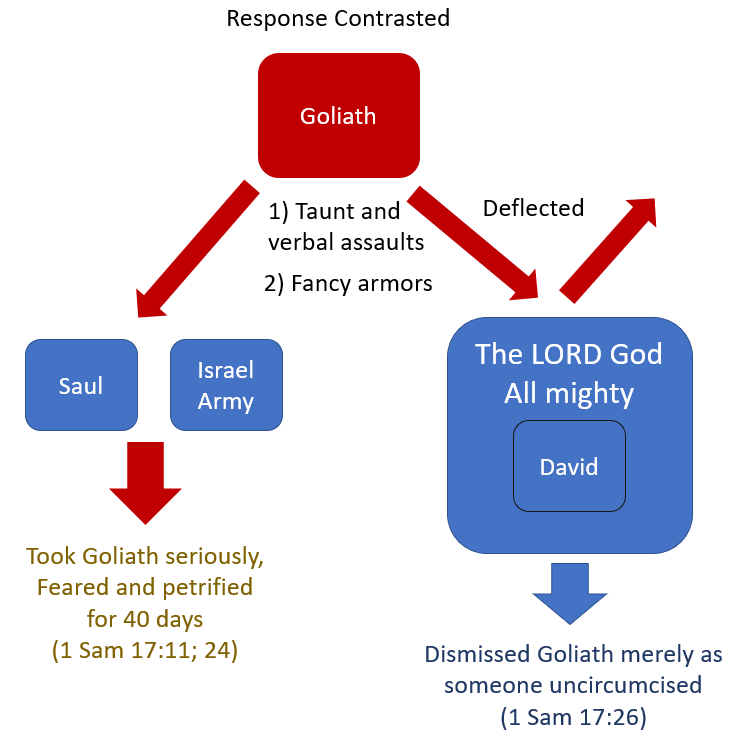
Fear is contagious and can be powerful. It can be amplified to petrify the entire national army for 40 days. However, those who are rooted in the covenant of the LORD can reject that kind of fear.

Summary

The camp of Israel and Philistines gathered at the opposite side of the Valley. Goliath, a heavily-armored Philistine of more than 9 feet tall, provoked the army of Israel and instilled fear into the heart of Saul and the entire Israelites. The entire Israelite army continued to be petrified for 40 days as the taunt of the Philistine continued. 

David came to the camp to provide supplies to his brothers, who were among the armies. He heard the taunting of the Philistine and became indignant. 

Contagious Fear

Who was the natural person to lead the Israel army when Goliath, the Philistine, taunted and defied them? That would be Saul himself. Not only was he the king, but he was also a very tall person as well. King Saul may not have been as tall as Goliath, but he was described as a head taller than the rest of the Israelites (1 Sam 10:23). 

His leadership greatly mattered. Yet, he fell into fear (17:11), and that was not good. When a leader fell into fear, the effect of fear would amplify to his/her followers. Therefore, the entire Israel greatly feared and was dismayed. 

Source of Fear

Although Saul was the legitimate, appropriate choice to fight Goliath one-on-one, he did not have to fight Goliath himself. It would not be rational to send a king to fight one-on-one battle. However, King Saul had no reason to fear Goliath, either. 

Then, what was the source of the fear? The primary source of fear was the absence of the Lord God in the heart and mind of Saul and the entire nation of Israel. 

As Saul disobeyed the word of the Lord, Saul was rejected being king (15:23). The Spirit of the LORD was no longer with Saul. Without the protection of the LORD God, Saul was vulnerable to succumbing under fear. Also, this was the time of Judges (1 Samuel 1:3) during which people did whatever they saw fit and they showed no honor to God. The Spirit of the LORD was absent in the top national leader, Saul, and in Israel as a nation had little fear of God. In the absence of the fear of the LORD God, something would fill that void. That would be the fear of men. Saul and the Israel army allowed the fear of men, in this case, Goliath, to fill the void created by the absence of the fear of God.

The secondary reason for fear was the wrong focus. Note that the author intentionally described the details of Goliath’s armor, helmet, shield, and spear to highlight the splendor of them (17:4-7). Their combined weight was estimated to be more than 60lb. Saul and the Israel army allowed their vision to be captivated by the splendid armor and weapons and their ears to be captured by the taunts of Goliath. The fear that started with Saul spread to the rest of the Israel army. 

Solidification of Fear: Goliath’s Eighty “Psalms”

Although the fear was contagious, it could have been contained early. However, Saul and Israel allowed the fear to solidify. 

The Israel army allowed and yielded an open forum, the valley of Elah, to Goliath for the opening of his insults and mockery of the LORD God and the Israelites army freely. For the next forty days, in the morning and evening, the Philistine would come out to taunt the living God and defy the Israelites. Given that he did this twice a day, his taunt went on for eighty times, which continued to assault the mentality and spirits of the Israel army. As sound travels upward, his morning and evening taunt traveled upward and transmitted to both the Philistines and the Israelites: a booster effect on the Philistines and debilitating effect on the Israelites. 

By listening to the eighty “psalms” of Goliath, the fear of Saul and the Israel army was cemented day by day, to a point of no recovery: they fled from Goliath and were greatly afraid (17:24). Because they allowed the message of the Philistine to form and cement their fear, Israel had no chance. 

Fear Repelled: Identity in the Covenant of the Lord God

While Saul and the entire Israel were under fear, David came to the battlefield unaffected by their fear. When he heard the 81st “psalm “of Goliath, he responded very differently from Saul and all Israel. 

Unlike Saul, David showed himself to have a firm identity in the LORD and under His covenant. He dismissed Goliath as merely someone who was uncircumcised (17:26). To David, the enormous and splendid armor and weapons were invisible, and instead he focused this battle from the perspective of God’s covenant. Then, David possibly spotted the major weaknesses of Goliath, his mobility and his large surface area. Given that he was a very tall man, his shield bearer was not able to cover his face, which David might have seen as an opening for his slingshot. With this focus, instead of allowing external visual and hearing inputs to dictate his perspective, David stayed firm within God’s truth to set his thought and perspective straight against Goliath.

What to do with fear?

Fear is powerful. However, God is far more powerful. Almost all Israel succumbed to fear when Goliath taunted and defied them. However, David had his identity firmly rooted in the LORD God to assess the overall situation from God’s perspective. He simply rejected it.

Do not let fear dictate your thoughts. Do not let fear take the open forum. Instead, squash it with your identity in the LORD God as David did.

1 Samuel 16 Part 2 (16:14-23): David the Polymath, a Man After God’s Heart

Summary

Meanwhile, the Spirit of the LORD departed from Saul, and he was being terrorized by an evil spirit. Saul’s servants recommended that he brought David, a skillful musician, a mighty warrior, and a man of God to sooth his terror from an evil spirit. David was brought before Saul, and whenever the evil spirit tormented Saul, David would play the harp to refresh and soothe Saul. Saul loved David greatly.

Identity in the Spirit of the LORD

The name David means “beloved.” Indeed, he was the beloved man of God.

Notice that the name David does not appear until the arrival of the Spirit of the LORD mightily upon him. Before that, he was referred to as the youngest who was tending the sheep (16:11). Even after he was brought in, only the descriptions of him were given – ruddy with beautiful eyes and a handsome appearance (16:12). The Lord confirmed that he was the anointed one. Only after the mighty coming of the Spirit of the LORD, his full identity – David – was revealed to the readers (16:13).

David’s Reputation

Although only a young shepherd, David already earned a reputation as a man of God. One of Saul’s servants described David as “a skillful musician, a mighty man of valor, warrior, one prducent in speech, and a handsome man; and the Lord is with him (16:18).” 

Where did this reputation come from? We can trace his reputation back to that of Ruth, his great-grandmother. In the book of Ruth, Boaz was already aware of Ruth’s reputation: the kindness that Ruth demonstrated for her mother-in-law after the death of her husband and the courage to leave her people, the Moabites, to come to join the people of God (Ruth 2:11). Boaz stated that “all my people in the city know that you are a woman of excellence (Ruth 3:11).” Ruth was recognized as a woman of excellence by her godly respect of her mother in law, late husband, the LORD’s people, and her diligent work ethic.

From a godly great-grandmother Ruth came David. He demonstrated a similar set of godly attributes, and he became well-known, even to a young servant of Saul. Although a widow and a shepherd, they let their light shine before people as Jesus said of his followers: “You are the light of the world… let your light shine before men in such a way that they may see your good works, and glorify your Father who is in heaven (Matthew 5:14-16)”

David the Meek Polymath

Some of the well-known descriptors of David include the following: David the shepherd, David the man after God’s own heart, David the slingshotter, David the sinner, etc. However, I would like to give him a new descriptor from a new perspective: David the Polymath

Polymath: An individual whose knowledge spans a substantial number of subjects, known to draw on complex bodies of knowledge to solve specific problems (wikipedia)

The importance of polymath is not necessarily the variety of expertises, but the ability to maintain a humble posture to be teachable and learn new things in order to connect a variety of subjects that are seemingly unconnectable. David was a polymath – skillful in multi-disciplines. Being a polymath probably allowed David to experience God from a variety of angles.

David was described as “a skillful musician, a mighty man of valor, warrior, one prducent in speech, and a handsome man; and the Lord is with him (16:18).” He was a skillful musician – his softside to sooth other people from anxiety and his main tool to worship the LORD God. On the other hand, he was a fierce, mighty warrior. When the time required him to protect his flock and sheep from predators like lions and bears, he was fierce, putting his life to protect them. Finally, he was prudent in speech. What does it mean by being prudent in speech? Not the eloquence, but the use of speech in Psalms and hymns to encourage and give life to people around him and vertically honor and worship the LORD God. In other words, being prudent in speech is equivalent to loving God and loving your neighbor.

These attributes demonstrate that David was meek: power under control. David used his power, slingshot, to protect the weak, his flock and sheep, from the fierce enemies, lions and bears. Jesus was the most meek person. Jesus, the most powerful “person,” used His power to protect and save the weak, us, from the ultimate power of the enemy, the eternal death.

David served Saul

Multi-talented David served Saul. Whenever Saul was under torment, David would play the harp to help Saul overcome the evil spirit (1 Samuel 16). David, who was full of the Spirit of God, could have looked down on King Saul, who was under torment from the evil spirit. In addition, David knew that he was anointed by Sameul, a more reason not to serve King Saul with all of his heart. David could have fallen to a trap of self-righteousness over King Saul. However, David faithfully used his musical talent to sooth King Saul’s pain. David probably used his musical talent and harp to praise God, and the invitation of presence of God allowed King Saul to withstand the torment from the evil spirit.

Conclusion

David found his identity in the Spirit of the LORD. David’s multiple talents allowed him to experience God from a variety of ways. David used his talents to serve those who were in need.

1 Samuel 16 Part I (16:1-13): Covert Operation by the LORD God and Samuel

King Saul was rejected. Prophet Samuel was dejected. But, the LORD God selected. Despite Saul’s failure as king of Israel, the LORD continued to work out His redemptive plan – with Samuel through David, and eventually to Christ.

Recap of 1 Samuel 16:1-13

The Lord told Samuel to overcome his grief over Saul and go down to Bethlehem to anoint a king that the LORD Himself had selected, one among the sons of Jesse. Samuel obeyed promptly and went down from Ramah to Bethlehem to anoint the one that the LORD had selected. Jesse made seven of his sons pass before Samuel, but none of them were selected. Finally, the youngest son was brought in, and the LORD indicated that he was the selected person. Samuel anointed him, and the Spirit of the LORD came mightily upon David. 

The LORD God is active

One of the key words in the first half of the chapter is “for Myself.” God chose a king for Himself. Previously, the LORD allowed the people of Israel to choose their king. In accordance with their desire, value, and criteria, Saul was chosen as king (1 Samuel 8-10). Saul was the king that reflected the desire of the people of Israel to become like other nations. Because Saul’s heart was not completely devoted to the LORD God, he failed and God subsequently rejected him. 

However,  the LORD continues to work out His plan even when man fails. He rose up and by working with an individual who feared Him, such as Samuel, the LORD chose the king to continue to further His redemptive plan. 

Macro Perspective: Book of Judges vs. Book of Ruth 

1 Samuel 16 depicts a major turning point for the nation of Israel and more broadly, a redemptive plan of God for man. In some way, 1 Samuel 16 directly follows the book of Ruth with two main connections: Bethlehem and David. In the book of Ruth, the redemption took place in Bethlehem and ended with the introduction of David in the genealogy that includes Boaz and Ruth. 1 Samuel 16 brings back both Bethlehem and David to be connected to the book of Ruth. In contrast, previous chapters in 1 Samuel (from 1 to 15) are continuation of the book of Judges 

The book of Judges vividly depicts how far the people of God can fall away: everyone did what was right in his own eyes (Judges 21:25). The book describes national-scale massacre and oppression of the weak (Judges 21), corrupt worship system (Judges 17), fallen priests (Judges 19), and powerless people of God against adversaries. Despite their calling to be the people of God to be the light and hope for other nations, they failed to heed the LORD’s words and commandments. They followed the way of other nations by worshiping false gods and oppressing their fellow brothers and sisters. 

Likewise, 1 Samuel starts with little changes from the periods of Judges – the word from the LORD was rare and visions were infrequent (1 Samuel 3:1). Why? Because the Israelites deliberately ignored the word of God, the LORD God stopped speaking to them – conversation is a two-way communication. Even the high priest at that time, Eli, failed to heed and listen to the LORD God. Eli was the high priest that was the byproduct from the anemic spiritual conditions during the period of Judges.

Yet, in contrast with the book of Judges, the book of Ruth was where the promise of God and His redemptive plan reignited – from a relatively invisible city of Bethlehem. The event started with two widows, Naomi and Ruth: the people in the lowest economic ladder. However, Ruth demonstrated loving-kindness (hesed) to Naomi, her mother-in-law, and to the dead husband, and came to join the people of God in Bethlehem for love of the LORD God. Ruth proved herself to be a woman of God, and Boaz, a man of God, redeemed the family of Naomi by marrying Ruth. After a few generations, David was born from this genealogy. 

Micro Perspective: Intimate, Covert Operation 

The whole content of the text, 1 Samuel 16:1-13, signifies the intimate, close relation between the LORD God and Samuel. Both were on a secret, stealth mission to anoint a new, future king for Israel, who would eventually be a physical ancestor of Christ. Given that this was an incredibly important mission, we can see that the LORD God trusted Samuel and the LORD God loves to work with His people. 

By the way, why did this mission have to be stealthy, secretive?

First, there was a practical reason: to protect Samuel from Saul. See how Samuel responded to the LORD’s command in honesty and in worries that Saul might kill him if Saul found out that Samuel went down to Bethlehem to anoint a new king (16:2). The LORD provided a solution to disguise this trip to Bethlehem as a peace offering event. The LORD God heard and empathized with Samuel’s concern to provide him with a wise tactic. Just as the LORD did with Samuel, God does hear our concerns to give us a wise solution. 

Second, the stealthy nature of this anointing mission aligned well with the character of God, especially associated with the way He works out His plan. Let’s go back to the book of Ruth and the book of Judges. The book of Judges was filled with visible, national headline events: national wars, civil wars, gruesome death of a concubine and her chopped body, etc. Notwithstanding these national-scale events and battles, God’s verdict on the people of Israel was that everyone did as they saw fit with little reverence to God and His work. In contrast, the book of Ruth depicts the work of the LORD God that started in a small town of Bethlehem with two helpless widows. His firm, redemptive plan was stealth and invisible, but firm and unstoppable in the book of Ruth. Likewise, the work of the Lord for selecting the next king, whose heart was aligned with Him, was stealth as it was conducted primarily by the man of God and the LORD on one-on-one basis. 

Imagine how cool it would be to have this secret mission with the LORD God based on an intimate personal relation. Contrast this with Eli, the previous high priest who preceded Samuel. There was rarely any vision from the lord to the Israelites (1 Samuel 3:1). Eli refused to listen to God and honored his sons more than he honored God (1 Samuel 2:29). The only significant message from the LORD God on Eli was a severe judgment (1 Samuel 2:32-36)). On the other hand, the LORD partnered with Samuel to complete this secret, stealthy mission of finding and anointing David. Samuel took the risk and quickly obeyed. 

Lesson for Samuel, a Man of God

The LORD God did not reveal everything about anointing the next king to Samuel. He led Samuel little by little. First, the LORD revealed that it would be among the sons of Jesse. Even after going through seven sons of Jesse, the LORD told Samuel that none of them were selected. Even Samuel had to go through this process. What was the lesson that the LORD wanted Samuel to learn? 

“…for God sees not as man sees, for man looks at the outward appearance, but the Lord looks at the heart”

1 Samuel 16:7 NASB

Let’s note that this was spoken to Samuel by the LORD God. Samuel was already a man of God, and he walked with God for many years since he was a child (1 Samuel 3). Yet, even Samuel was prone to be impressed by the appearance and the stature of a man. Even Samuel needed God’s direct message to stay alert to perceive the inner heart of man instead of being impressed by the appearance of man. 

Conclusion

This passage can be looked at from a macro and micro perspective. From a macro perspective, we see God continues to work out His plan, which may be stealthy and covert, but would not stop. From a micro perspective, we see that God works with His person (or people) intimately and through this process, He wants His people to learn a valuable lesson.  

I pray that every follower of Christ will have this kind of amazing opportunity to work with God that becomes an integral part of His macro work of redemptive plan.